


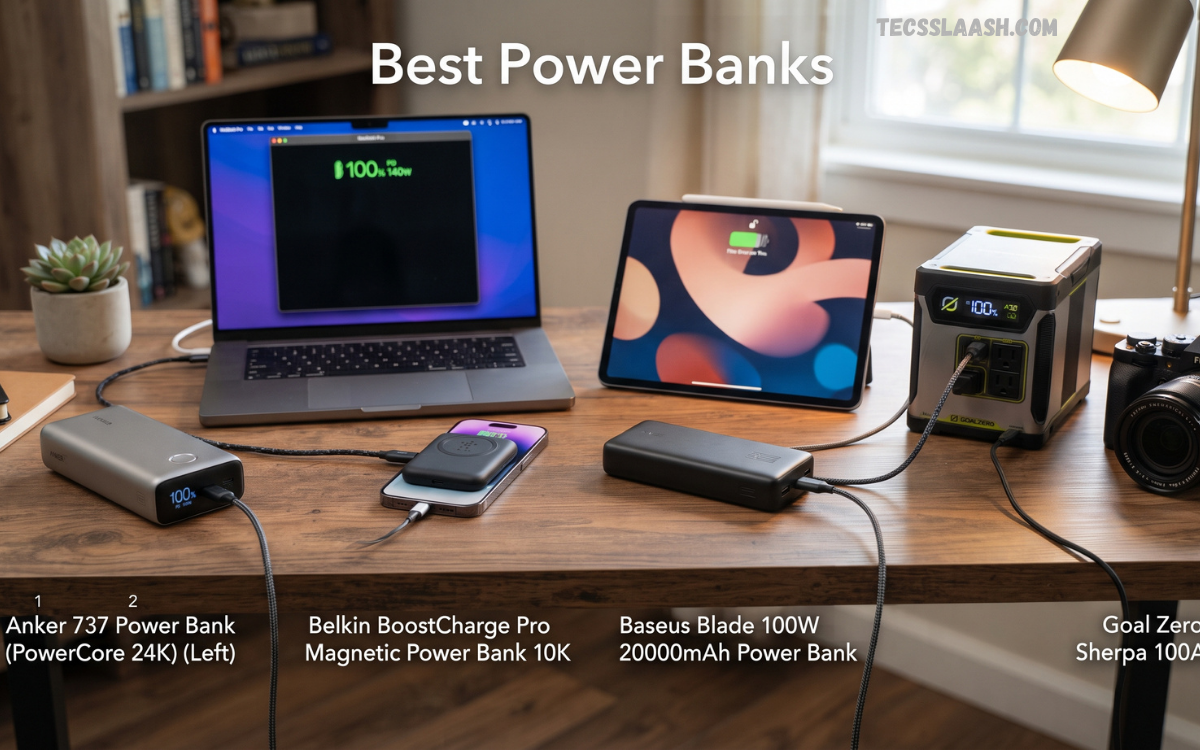
A reliable power bank has become an essential accessory for smartphones, tablets, wireless earbuds, smartwatches, cameras, gaming devices, and other portable electronics. Modern users depend on their devices throughout the day for communication, work, entertainment, navigation, photography, payments, and productivity.
The right portable charger should balance capacity, charging speed, portability, safety, compatibility, durability, and useful features. Some power banks are designed for lightweight daily carry, while others provide enough power for tablets and laptops.
What Is a Power Bank?
A power bank is a portable battery system designed to store electrical energy and transfer that energy to compatible electronic devices. Most models contain rechargeable lithium-ion or lithium-polymer battery cells, a control circuit, charging ports, and protective components.
Power banks vary significantly in size, capacity, output, charging technology, and design. Compact models can fit inside a pocket and provide enough energy for an emergency smartphone charge, while larger units can contain enough capacity to recharge several devices.
Why You Need the Best Power Bank?
Smartphone batteries continue to improve, but heavy usage can still drain them quickly. Activities such as video streaming, gaming, GPS navigation, photography, mobile hotspot use, and video calls can consume substantial battery power.
The Best Power Banks also provide flexibility because they can support multiple types of devices. A single portable charger may power a smartphone, wireless earbuds, smartwatch, tablet, camera, or compatible laptop.
Understanding Power Bank Capacity
Power bank capacity is commonly measured in milliampere-hours, abbreviated as mAh. A higher mAh rating generally means the power bank stores more energy, although the actual usable output is lower than the advertised capacity because energy is lost during voltage conversion and charging. For example, a high-capacity power bank may not deliver its entire rated capacity directly to a smartphone battery.
A 5,000mAh model can be suitable for emergency top-ups and lightweight daily use, while 10,000mAh models provide a stronger balance between portability and capacity. A 20,000mAh power bank is more appropriate for frequent travelers, heavy users, tablets, gaming devices, and multiple charging sessions. Larger capacities can provide greater endurance but usually increase weight and physical size.
5,000mAh Power Banks
A 5,000mAh power bank is designed primarily for portability. Its compact dimensions make it convenient for pockets, handbags, small backpacks, and short trips. These models are useful when users need additional battery life during a busy day rather than several complete charging cycles.
The main advantage is convenience. A small power bank is easier to carry than a large-capacity model and can serve as an emergency backup when a smartphone battery becomes critically low. Users who prioritize minimal weight should consider compact 5,000mAh models among the Best Power Banks for occasional charging.
10,000mAh Power Banks
A 10,000mAh power bank is one of the most practical choices for everyday smartphone users. It offers significantly more stored energy than compact models while remaining reasonably portable. Depending on the smartphone, charging conditions, battery efficiency, and power-bank design, a 10,000mAh unit can provide multiple partial charges or approximately one to several charging cycles.
This capacity works well for commuting, office use, university, travel, photography, and weekend activities. Users who want a balance between capacity and portability often find 10,000mAh models particularly convenient. A strong 10,000mAh power bank with modern USB-C output can also provide useful versatility for multiple personal devices.
20,000mAh Power Banks
A 20,000mAh power bank is designed for users who require greater battery endurance. It can provide multiple smartphone charges and is particularly useful for long journeys, outdoor activities, business trips, gaming sessions, and situations where electrical outlets are unavailable for extended periods.
The trade-off is increased weight and size. Carrying a 20,000mAh power bank in a pocket may be less comfortable than carrying a smaller model, but the additional capacity can be valuable when reliability matters more than portability. Users with several devices should consider 20,000mAh models when selecting the Best Power Banks for extended use.
Charging Speed and Power Output
Capacity is only one part of power-bank performance. Charging speed depends heavily on output power, supported charging protocols, cable quality, device compatibility, and the device’s own charging limitations. A power bank with a large capacity but low output may take considerably longer to recharge a modern smartphone than a smaller model supporting high-speed charging.
Look for power banks that clearly state their output specifications. USB-C Power Delivery, commonly known as USB-C PD, is particularly important for modern devices because it can provide higher power levels and efficient charging. Depending on the model, higher-wattage power banks can also support tablets and compatible laptops, making them more versatile than basic USB chargers.
USB-C Power Banks
USB-C has become an important standard for modern charging because it supports high-speed power delivery and data connectivity. Many current smartphones, tablets, headphones, gaming devices, and laptops use USB-C connections. A power bank equipped with USB-C input and output can therefore simplify charging and reduce the number of cables users need to carry.
The Best Power Banks increasingly feature USB-C Power Delivery because of its flexibility and performance. Some models allow the same USB-C port to recharge the power bank itself and charge another device. Before purchasing, users should verify the supported wattage, charging protocols, cable requirements, and compatibility with their devices.
USB-A Ports and Multi-Port Charging
USB-A remains useful because many older cables and accessories continue to use the traditional connector. A power bank with both USB-C and USB-A ports can provide broader compatibility for users who own a mixture of modern and older devices. Multiple ports can also allow several devices to receive power simultaneously.
However, multi-device charging may divide available output power depending on the power bank’s design. A model advertised with a high maximum output may deliver different power levels when multiple devices are connected. Buyers should check the detailed output specifications instead of relying only on the maximum wattage displayed on the packaging.
Fast Charging Technology
Fast charging can significantly improve the usefulness of a power bank. Instead of waiting for a device to recharge for several hours, compatible fast-charging technology can restore substantial battery capacity within a shorter period. This is especially valuable for people who frequently travel or have limited access to charging outlets.
Different manufacturers and devices support different charging standards. USB Power Delivery is widely used across modern electronics, while other technologies may be supported by specific brands or device families. The best approach is to choose a power bank that supports the charging standard used by your primary devices rather than selecting a model solely because it advertises a high wattage.
Laptop-Compatible Power Banks
Not every power bank can charge a laptop. Laptops typically require substantially higher power than smartphones, meaning the power bank must provide adequate wattage through a compatible USB-C Power Delivery connection. Some high-capacity models are specifically designed for laptops and can deliver enough power for compatible notebooks.
When purchasing a laptop-compatible model, check the required charging wattage of the laptop and compare it with the power bank’s sustained USB-C output. Capacity is also important because laptop batteries are much larger than smartphone batteries. For professionals who work remotely, a high-capacity USB-C PD power bank can provide valuable backup power during flights, meetings, travel, and power interruptions.
Power Banks for Travel
Travel places unique demands on portable chargers. A travel power bank should provide sufficient capacity without becoming unnecessarily heavy. It should also have reliable charging performance, durable construction, and convenient ports for the devices carried during the trip.
Airline regulations can also influence which power banks travelers can carry. Lithium battery restrictions are commonly based on watt-hour ratings, and airlines may have specific requirements for carrying spare lithium batteries. Travelers should verify the latest airline and airport rules before flying, particularly when carrying high-capacity models.
Power Banks for Gaming
Mobile gaming can drain smartphone batteries quickly because demanding games require sustained processing, graphics performance, display brightness, and network connectivity. A suitable power bank can keep a gaming device operational during long sessions without requiring a nearby wall outlet.
Gamers should prioritize high output, stable power delivery, sufficient capacity, and convenient cable positioning. A 10,000mAh or 20,000mAh model can be practical depending on the gaming device and usage duration. USB-C PD support is particularly useful for modern gaming smartphones and handheld gaming devices that require higher charging speeds.
Power Banks for iPhone Users
iPhone users should pay attention to USB-C compatibility, charging standards, capacity, and cable requirements when choosing a portable charger. Modern iPhone models can benefit from fast charging when paired with an appropriate power bank and compatible cable. Older Lightning-based devices require the appropriate connection or cable.
Magnetic wireless power banks can provide additional convenience for compatible iPhone models. These designs attach magnetically to supported devices and can reduce cable clutter. However, wired USB-C charging can still offer faster and more efficient power transfer in many situations, making it important to compare convenience against charging performance.
Power Banks for Android Phones
Android smartphones vary considerably in battery capacity, charging technology, and connector type. Most modern Android phones use USB-C, but charging speeds can differ dramatically between brands and models. Some devices support high-wattage proprietary charging systems that may not operate at their maximum speed with a generic power bank.
For Android users, compatibility should therefore be a priority. Check the smartphone manufacturer’s recommended charging specifications and select a power bank capable of providing appropriate output. A high-quality USB-C PD model is often a versatile choice, particularly when the phone supports USB Power Delivery.
Wireless Power Banks
Wireless power banks allow compatible devices to receive energy without connecting a physical charging cable. This can make charging more convenient, particularly when users want to avoid carrying or repeatedly connecting cables. Some models combine wireless charging with conventional USB ports for greater flexibility.
Wireless charging generally introduces additional energy losses and can generate more heat compared with wired charging. As a result, wireless power banks may not always provide the same efficiency or charging speed as a direct cable connection. Users should view wireless functionality as a convenience feature rather than automatically assuming it represents the fastest charging option.
Read Also: Best Fast Chargers: Top Picks for Quick and Efficient Charging
Safety Features to Look For
Safety should be a major consideration when selecting the Best Power Banks. Quality models typically include protective circuits designed to reduce risks associated with overcharging, over-discharging, overheating, short circuits, and excessive current. These systems help protect both the power bank and connected electronics.
Buyers should purchase products from reputable manufacturers and avoid suspiciously cheap models with unclear specifications. A power bank contains rechargeable battery cells capable of storing substantial energy, so construction quality and battery management systems matter. Certification markings, manufacturer information, warranty coverage, and credible reviews can help identify safer products.
Build Quality and Durability
A power bank may spend considerable time inside a backpack, pocket, luggage compartment, or desk drawer. Strong construction can help protect it against scratches, minor impacts, and everyday wear. Some models use aluminum or reinforced plastic housings, while rugged versions may include additional protection for outdoor environments.
Design should also account for port durability and cable connections. Loose or poorly constructed ports can reduce reliability over time. A well-designed power bank should have secure connectors, clear indicators, accessible buttons, and a housing that feels solid without adding unnecessary weight.
LED Indicators and Digital Displays
Basic power banks often use four small LED indicators to show approximate battery levels. More advanced models may feature digital displays that provide a numerical percentage. A digital display can make it easier to determine how much energy remains before leaving home or starting a trip.
Although displays do not directly improve charging performance, they improve usability. Users can avoid discovering that a power bank is nearly empty only after connecting a device. This feature is especially helpful for travelers and people who depend on portable charging as an emergency backup.
Compact Design Versus High Capacity
The ideal balance between portability and capacity depends on how the power bank will be used. A compact model is easier to carry every day, but it offers fewer charging cycles. A larger model provides more energy but occupies more space and adds weight to a bag.
Daily commuters may prefer a lightweight 5,000mAh or 10,000mAh unit, while travelers and outdoor users may benefit from 20,000mAh capacity. The Best Power Banks are not necessarily the largest or most powerful models; they are the ones that provide appropriate performance without unnecessary bulk.
Power Bank Efficiency
Power-bank capacity ratings should not be interpreted as the exact amount of energy a device will receive. Internal battery cells operate at one voltage, while connected devices may require another voltage. The conversion process results in energy losses, and additional losses can occur through cables, connectors, and charging circuits.
Temperature, charging speed, battery condition, and power-management systems can also influence efficiency. This is why two power banks with identical capacity ratings may provide slightly different real-world results. Buyers should consider independent testing and practical reviews when comparing performance.
How to Choose the Best Power Banks
Start by identifying the devices you intend to charge. A smartphone-only user may not need a large laptop-capable power bank, while someone carrying a phone, tablet, camera, earbuds, and laptop may benefit from a high-capacity multi-port model. Knowing the intended use prevents unnecessary spending on features that will never be used.
Next, compare capacity, output wattage, charging protocols, ports, size, weight, safety features, and warranty support. A well-balanced power bank should provide enough capacity for your normal usage while remaining practical to carry. Price should be considered alongside specifications and manufacturer reputation rather than treated as the primary deciding factor.
Common Power Bank Buying Mistakes
One common mistake is choosing a power bank solely because it has the highest mAh rating. Capacity is important, but a huge battery with slow charging output may provide a poor experience. Another mistake is ignoring USB-C Power Delivery compatibility when purchasing a charger for modern devices.
Buyers also sometimes overlook weight, dimensions, port configuration, and safety features. A power bank that is technically powerful but too heavy to carry regularly may spend most of its life unused. Similarly, a model without sufficient output may fail to charge a laptop or high-performance device effectively. Selecting based on actual usage requirements leads to better long-term value.
How to Maintain a Power Bank
Proper maintenance can help preserve battery performance. Avoid exposing the power bank to extreme heat, direct sunlight, excessive moisture, or physical damage. Store it in a dry environment and avoid placing heavy objects on it. If the manufacturer provides specific storage recommendations, follow those instructions.
Recharge the power bank when necessary rather than leaving it completely depleted for long periods. If it will not be used for an extended time, storing it according to the manufacturer’s recommended charge level can help maintain battery health. Replace a power bank if it becomes swollen, unusually hot, damaged, or otherwise unsafe.
Are Expensive Power Banks Better?
A higher price does not automatically guarantee better performance. Premium power banks often provide stronger build quality, higher output, advanced charging protocols, better displays, additional ports, improved thermal management, or stronger warranty support. However, many affordable models can deliver excellent performance for users with basic requirements.
The best value comes from matching specifications with actual needs. A smartphone user who only needs emergency charging may not benefit from paying for laptop-level output. Conversely, a professional who depends on a power bank for multiple devices may save money in the long term by purchasing a higher-quality model rather than repeatedly replacing cheaper units.
Best Power Banks for Everyday Use
For everyday use, a 10,000mAh power bank with USB-C input and output is often an excellent starting point. It provides a useful balance between capacity, portability, and charging flexibility. Fast charging support can make it even more practical for people who frequently need quick battery boosts during work or travel.
Users who carry multiple devices should consider models with several ports and sufficient total output. A power bank capable of intelligently distributing power can charge more than one device without requiring separate chargers. The ideal everyday model should remain small enough to carry comfortably while providing enough energy for an average day.
Best Power Banks for Long Trips
Long-distance travel requires greater capacity and reliability. A 20,000mAh model can provide substantially more stored energy than smaller portable chargers, making it useful during flights, road trips, camping, or extended periods away from electrical outlets.
Travelers should also consider weight, airline requirements, charging speed, and port compatibility. A model with USB-C Power Delivery can reduce the number of chargers required for modern devices. Before traveling by air, always check the current airline policy regarding lithium-ion power banks and permitted battery capacities.
Best Power Banks for Multiple Devices
People carrying smartphones, tablets, headphones, cameras, and other electronics should prioritize capacity and multi-port functionality. A high-capacity power bank with multiple outputs can serve as a centralized charging solution, reducing the need to carry several individual power adapters.
Output management is equally important. Check how much power the power bank can deliver when multiple devices are connected simultaneously. A high maximum output on a single port does not necessarily mean the same output will remain available across all ports at once.
Frequently Asked Questions
What are the Best Power Banks for everyday use?
The Best Power Banks for everyday use usually offer 10,000mAh capacity, USB-C charging, fast charging support, compact design, and reliable safety features. This combination provides a practical balance between portability and battery backup for smartphones, earbuds, and other small devices.
How many mAh should a good power bank have?
A 10,000mAh power bank is a strong choice for most everyday users. A 5,000mAh model works well for lightweight emergency charging, while a 20,000mAh model is better for long trips, multiple devices, tablets, and extended periods away from a power outlet.
Are higher-capacity power banks better?
Higher capacity provides more stored energy, but it also usually increases size and weight. The best option depends on your requirements. A compact power bank may be more convenient for daily carrying, while a larger model is better for travel and heavy device usage.
Can a power bank charge a laptop?
Yes, some high-capacity power banks can charge compatible laptops. Look for USB-C Power Delivery and sufficient wattage for your laptop. Always compare the laptop’s charging requirements with the power bank’s maximum USB-C output before purchasing.
Are USB-C power banks better?
USB-C power banks are generally more versatile for modern devices because USB-C supports fast charging and higher power delivery. Many smartphones, tablets, gaming devices, headphones, and laptops now use USB-C, making it a useful feature when selecting a portable charger.
How long does a power bank last?
A power bank’s lifespan depends on battery quality, charging frequency, temperature, storage conditions, and overall usage. A quality power bank can provide reliable service for several years when properly maintained and protected from excessive heat, moisture, and physical damage.
Can power banks charge multiple devices simultaneously?
Yes, many power banks include multiple USB-A or USB-C ports that allow users to charge several devices simultaneously. However, available power may be divided between connected devices, so check the manufacturer’s multi-port output specifications before buying.
Are power banks safe to use overnight?
Quality power banks include protection against conditions such as overcharging, overheating, excessive current, and short circuits. However, it is still preferable to follow the manufacturer’s charging recommendations and avoid using damaged, swollen, or unusually hot power banks.
Can I take a power bank on an airplane?
Power banks are generally treated as spare lithium batteries, so airline and aviation restrictions apply. Capacity limits and carry-on requirements can vary by airline and jurisdiction. Check the latest rules of your airline before traveling with a high-capacity power bank.
What should I check before buying a power bank?
Check battery capacity, USB-C support, output wattage, fast-charging protocols, number of ports, size, weight, safety protections, build quality, manufacturer reputation, and warranty. Choosing based on your actual devices and charging requirements will help you find the Best Power Banks for your needs.
Conclusion
Choosing the Best Power Banks depends on capacity, charging speed, compatibility, portability, safety, and intended usage. A compact 5,000mAh model can be ideal for emergency charging, while a 10,000mAh power bank offers an excellent balance for everyday smartphone users.
The most important principle is to match the power bank with the devices and situations you actually use. Check charging requirements, output wattage, capacity, safety features, dimensions, weight, and warranty coverage before purchasing.

