


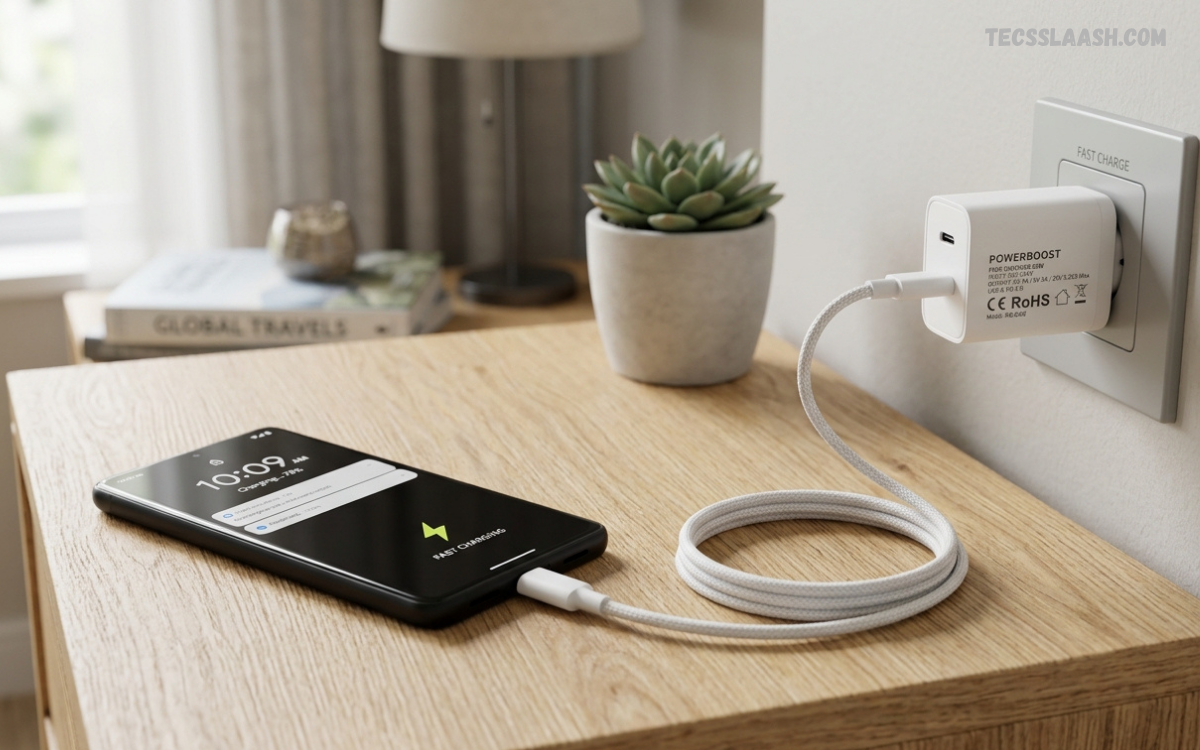
A fast phone charger can reduce charging time and make daily smartphone use more convenient. Modern smartphones support advanced charging technologies that deliver higher power than traditional chargers. Choosing the right charger depends on phone compatibility, charging standards, cable quality, and power requirements.
A reliable charger should provide consistent power without creating unnecessary heat or instability. Different smartphones support different charging speeds, so checking the device specifications remains important.
What Is a Fast Phone Charger?
A fast phone charger is a charging adapter designed to deliver electrical power to a compatible smartphone at a higher rate than a conventional charger. Fast charging generally depends on voltage, current, charging protocols, and the phone’s internal charging system. The smartphone controls how much power it accepts during the charging process.
Fast charging does not mean every phone will charge at the charger’s maximum advertised wattage. A smartphone accepts only the power supported by its hardware and software. Using a higher-wattage adapter can still be useful when it supports the phone’s required charging standard.
How Does Fast Charging Work?
Fast charging works by increasing the amount of power transferred from the adapter to the smartphone. Power is commonly measured in watts, calculated from voltage and current. A compatible charger and phone communicate to establish an appropriate charging level.
Modern charging systems can adjust power during different stages of the charging cycle. The phone may accept higher power when the battery level is low and reduce power as the battery approaches full capacity. This approach helps balance charging speed, temperature, and battery protection.
Why Choose a Fast Phone Charger?
The main benefit of a fast phone charger is reduced charging time. Users can connect a smartphone for a short period and gain enough battery power for calls, messaging, navigation, entertainment, or other everyday activities. This can be especially useful during busy schedules.
Fast charging can also improve convenience when access to a power outlet is limited. Instead of keeping a phone connected for several hours, users may reach a useful battery level within a shorter period. Actual results depend on the smartphone, charger, cable, battery condition, and charging protocol.
Fast Phone Charger Wattage Explained
Charger wattage indicates the maximum power an adapter can potentially provide to a compatible device. Common charger ratings include lower-power options for basic devices and higher-power options designed for smartphones, tablets, and other electronics. Higher wattage does not automatically mean faster charging for every phone.
The smartphone determines the charging power it can accept. For example, a phone designed for a particular charging limit will not necessarily charge faster when connected to an adapter with a much higher wattage. Compatibility between the charger and phone remains more important than simply choosing the highest number.
USB-C and Fast Charging
USB-C has become widely used for modern smartphone charging because its connector supports multiple power and data standards. USB-C itself does not guarantee fast charging. Charging speed depends on the supported USB power specifications and the phone’s charging technology.
A quality USB-C cable can also affect charging performance. Some cables are designed to handle higher power levels, while others may have lower capabilities. Users should choose a cable that matches the charger’s power output and the smartphone’s charging requirements.
Fast Charging Protocols
Charging protocols allow the smartphone and charger to communicate about power requirements. Different manufacturers may support different technologies, including widely adopted USB-based standards and proprietary charging systems. A charger supporting the correct protocol can provide better compatibility.
A charger without the required protocol may still charge a smartphone, but charging speed can be lower. Before purchasing an adapter, users should check which charging standards their phone supports. Manufacturer specifications provide the most reliable information for compatibility.
Choosing the Right Fast Phone Charger
Choosing the right fast phone charger starts with checking the smartphone’s maximum supported charging speed. Users should then select an adapter capable of delivering that power through a compatible charging protocol. The cable should also support the required power level.
Build quality is another important consideration. A dependable charger should include appropriate protection against issues such as excessive current, overheating, and voltage irregularities. Buying from a reputable manufacturer can make it easier to verify specifications and safety features.
Fast Phone Charger for Android Phones
Many Android smartphones support fast charging, although charging speeds and protocols vary between brands and models. Some devices use USB Power Delivery, while others support additional manufacturer-specific technologies. The phone’s official specifications should always be checked before selecting a charger.
A compatible USB-C adapter can provide efficient charging when its power rating and protocol match the smartphone. Using the original adapter is often the simplest option, but a third-party charger can also work when it meets the required standards and quality expectations.
Fast Phone Charger for iPhone
Modern iPhones can support faster charging through compatible power adapters and cables. Depending on the model and charging setup, users may need an appropriate USB-C power adapter and compatible cable to achieve supported charging speeds.
The adapter’s wattage alone does not determine the final charging rate. The iPhone manages power intake according to its hardware, battery condition, temperature, and charging stage. Checking Apple’s specifications for the specific model can help users select an appropriate charger.
Importance of Charger Compatibility
Compatibility determines whether a charger can deliver its intended charging performance. Two adapters with similar wattage ratings can produce different results because they may support different protocols. The smartphone, adapter, and cable must work together for optimal charging.
Users should avoid choosing a charger based only on marketing claims. Checking supported standards, output ratings, connector type, and device compatibility provides a clearer picture of expected performance. This approach can also reduce the risk of purchasing an unsuitable accessory.
Fast Charging and Battery Health
Fast charging can generate more heat because higher power moves through the charging system. Modern smartphones use charging controls designed to manage temperature and power delivery. Battery health depends on several factors, including heat exposure, charging patterns, battery age, and device design.
Users do not need to avoid fast charging simply because it uses higher power. Instead, they should use compatible, quality charging equipment and avoid unnecessary heat during charging. Keeping the phone within recommended operating conditions can support normal battery performance over time.
Does a Fast Phone Charger Damage the Battery?
A compatible fast phone charger is designed to work within the smartphone’s supported charging limits. The phone manages the amount of power it receives rather than automatically accepting every watt the adapter can provide. Modern devices include charging management systems to regulate the process.
Battery aging is normal regardless of charging method. Heat, charge cycles, battery chemistry, and usage conditions all influence long-term battery capacity. Using certified or reputable charging accessories and following manufacturer guidance can help maintain safe charging conditions.
Fast Charging and Heat
Heat is one of the important factors involved in charging performance. Higher charging power can increase thermal output, particularly when the phone is being used heavily at the same time. Charging systems can reduce power when temperatures rise to protect the device.
Users can support better charging conditions by keeping the phone away from excessive heat while charging. Avoiding direct sunlight and heavy workloads during charging can reduce additional thermal stress. The phone’s built-in thermal controls remain an important part of safe charging.
Fast Phone Charger Cable Quality
The cable connects the charger to the smartphone and plays an important role in power delivery. A cable must support the required current and charging standard to deliver the expected performance. A low-quality or incompatible cable can limit charging speed.
Cable construction also affects durability. Frequent bending, pulling, or twisting can damage internal conductors over time. Choosing a properly rated cable from a reliable manufacturer can provide better consistency and reduce charging problems.
Wall Charger vs Wireless Charger
A wired fast phone charger generally provides more efficient power transfer than wireless charging because electricity travels directly through the cable. Wired charging can therefore reach higher charging speeds on many supported smartphones. Wireless charging offers convenience by removing the need for a physical connection.
Wireless charging technology has also improved, with modern systems offering faster charging than older wireless standards. However, actual wireless speed depends on the phone, charging pad, alignment, temperature, and supported protocol. Users should select the method that best matches their needs.
Fast Phone Charger for Travel
A compact fast charger can be useful when traveling because it reduces charging time and can replace multiple older adapters. Chargers with multiple ports can also power more than one compatible device from a single outlet. This can make a travel setup more convenient.
Travel users should check voltage compatibility, plug requirements, and regional electrical standards. A charger designed for the destination’s electrical system can help avoid compatibility problems. Compact GaN chargers are also popular because they can provide high power in relatively small designs.
GaN Fast Phone Chargers
Gallium nitride, commonly called GaN, is a semiconductor material used in many modern compact power adapters. GaN technology can allow chargers to achieve high power output while maintaining a smaller physical design compared with some traditional charger designs.
A GaN charger is not automatically faster than every conventional charger. Charging performance still depends on wattage, protocols, cable compatibility, and the connected smartphone. GaN mainly provides an efficient approach to designing compact, powerful charging equipment.
Multi-Port Fast Phone Chargers
Multi-port chargers allow users to charge multiple devices using one adapter. Depending on the model, a charger may include several USB-C ports or a combination of USB-C and USB-A ports. Power distribution varies between chargers.
When multiple devices are connected, the available power may be divided between ports. Users who need maximum charging speed should check the adapter’s power distribution specifications. A high total wattage does not necessarily mean every port can provide the maximum output simultaneously.
How to Maintain a Fast Phone Charger
Proper handling can extend the useful life of a charger and cable. Keep the adapter away from liquids, excessive heat, and physical damage. Disconnecting the cable by holding the connector rather than pulling the wire can reduce stress on the cable.
Storage also matters when carrying charging equipment. Avoid tightly wrapping the cable around the adapter or placing heavy objects on it. Regularly checking the cable and adapter for visible damage can help identify equipment that should be replaced.
Common Fast Charging Problems
A phone may charge slowly even when connected to a fast charger. Common causes include an incompatible cable, unsupported charging protocol, low-quality adapter, high device temperature, background activity, or a phone that has reached a charging stage where power is intentionally reduced.
Troubleshooting should begin with the simplest checks. Confirm that the adapter and cable are properly connected, inspect the cable, verify charger compatibility, and check the phone’s charging settings. If charging remains abnormal, manufacturer support can provide device-specific guidance.
Fast Phone Charger Safety Features
Quality charging adapters commonly include protection systems designed to manage electrical conditions. These can include safeguards related to overcurrent, overvoltage, overheating, and short circuits. The exact protections depend on the charger design and manufacturer.
Users should avoid damaged adapters or cables. Physical damage can cause electrical or charging problems that are hard to spot visually. Choosing reputable products with clearly stated specifications is a practical way to reduce unnecessary charging risks.
Read Also: Phone Charger: Complete Guide to Choosing the Right Charger
Can a Higher-Wattage Charger Charge Faster?
A higher-wattage adapter can charge a phone faster only when the phone supports the additional power and the complete charging setup is compatible. If the phone has a lower charging limit, it will regulate power intake rather than continuously accepting the adapter’s maximum output.
This makes compatibility more important than simply selecting the highest wattage available. A charger that matches the phone’s supported charging standard can provide efficient results without unnecessary excess capacity. Users should check official device specifications before purchasing.
Fast Charging While Using the Phone
Using a smartphone during charging can increase power consumption. Activities such as gaming, video recording, navigation, and high-resolution streaming may generate additional heat and reduce the net charging speed.
For faster charging, reducing demanding activities can help the phone dedicate more available power to battery charging. A cool environment and minimal device activity can also support more consistent charging performance.
Future of Fast Phone Chargers
Smartphone charging technology continues to develop toward higher power delivery, improved thermal management, smaller adapters, and more efficient charging systems. USB-C is becoming increasingly important as a common connector for many modern electronic devices.
Future chargers are likely to focus not only on higher wattage but also on intelligent power management. Better communication between devices, chargers, and cables can help optimize charging based on battery condition, temperature, and device requirements.
Frequently Asked Questions
What is a fast phone charger?
A fast phone charger delivers power to a compatible smartphone at a higher rate than traditional low-power charging equipment. Actual charging speed depends on the phone, adapter, cable, protocol, and battery condition.
Does higher wattage mean faster charging?
Not always. A phone accepts power according to its supported charging capabilities. A higher-wattage charger can provide additional capacity, but the smartphone controls how much power it actually receives.
Can I use a fast charger with any phone?
Most modern phones can charge with compatible adapters, but charging speed varies. Check the phone’s supported charging standard, connector type, and maximum charging power before selecting an adapter.
Is fast charging safe?
Fast charging can be safe when the charger, cable, and smartphone are compatible and designed according to appropriate safety standards. The phone also manages power and temperature during charging.
Does fast charging reduce battery life?
Battery capacity naturally declines over time. Heat, charging cycles, usage patterns, and battery chemistry can affect aging. Using compatible equipment and avoiding excessive heat supports normal battery operation.
Is USB-C required for fast charging?
USB-C is common for modern fast charging, but charging requirements vary by device. The connector alone does not guarantee fast charging because the charging protocol and power capability also matter.
Can a fast charger charge multiple devices?
Yes, multi-port chargers can charge multiple compatible devices. However, the total available power may be distributed among connected devices, which can affect individual charging speeds.
Why is my phone charging slowly with a fast charger?
Slow charging can result from an incompatible cable, unsupported protocol, excessive temperature, battery protection features, or heavy phone usage. Checking the complete charging setup can help identify the cause.
Are GaN chargers better?
GaN chargers can provide high power in compact designs. Whether one is suitable depends on the required wattage, charging standards, ports, size, and compatibility with the devices being charged.
How do I choose the right fast phone charger?
Check your phone’s maximum charging power, supported charging protocols, connector type, and cable requirements. Then choose a reputable charger that meets those specifications.
Conclusion
A fast phone charger can make smartphone charging more convenient by reducing the time required to reach a useful battery level. The best charging setup depends on compatibility between the smartphone, adapter, cable, and charging protocol rather than wattage alone.
Users should prioritize reliable specifications, appropriate power delivery, quality cables, and proper charging conditions. Understanding these factors makes it easier to choose a charger that delivers efficient performance while supporting safe and consistent everyday smartphone charging.

