


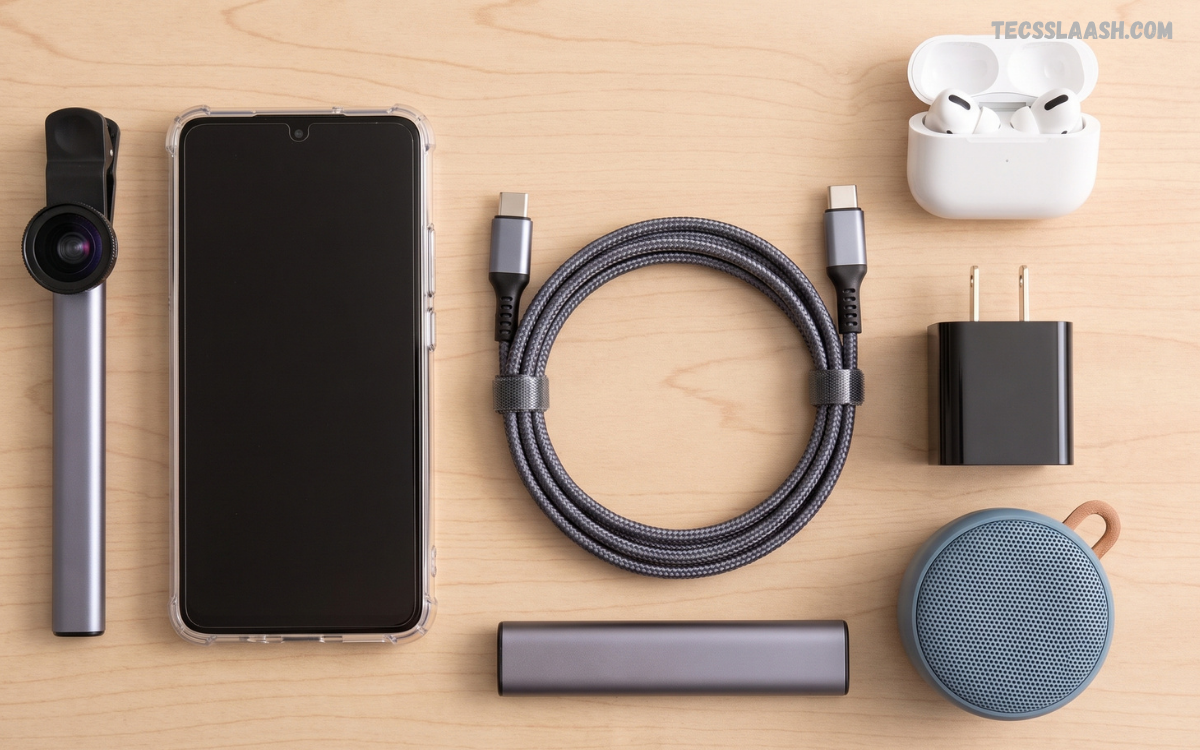
Smartphones have become essential tools for communication, entertainment, education, photography, gaming, work, and everyday tasks. The right accessories can improve a phone’s protection, charging experience, audio quality, portability, and overall convenience.
A good accessory should solve a real problem instead of adding unnecessary equipment. Phone cases can protect against accidental drops, screen protectors can reduce scratches, power banks can provide additional battery capacity, and wireless earbuds can make calls or entertainment more convenient.
What Are Mobile Accessories?
Mobile accessories are products designed to improve, protect, support, or extend the functionality of smartphones and other mobile devices. Common examples include phone cases, screen protectors, charging cables, wall chargers, wireless chargers, power banks, car mounts, phone stands, earbuds, headphones, Bluetooth speakers, gaming controllers, and camera accessories.
The mobile accessory market includes simple low-cost products and advanced technology designed for specific devices. Some accessories work with almost every smartphone, while others depend on factors such as USB connector type, wireless charging support, Bluetooth compatibility, phone dimensions, or operating system features. Checking compatibility before purchasing remains one of the most important steps.
Why Do Mobile Accessories Matter?
A smartphone represents a significant investment, making protection one of the main reasons to use accessories. A durable case and suitable screen protector can help reduce damage caused by everyday accidents. A reliable charger and high-quality cable can also provide a more dependable charging setup for home, school, travel, or work.
Accessories can also make smartphones easier to use. A stand can provide comfortable viewing during videos, a car mount can improve navigation convenience, and wireless earbuds can provide a cable-free listening experience. For people who use their phones heavily, the right accessories can improve daily comfort and reduce common problems.
1. Smartphone Cases
A smartphone case is one of the first accessories many users should consider. Cases are available in different materials, thicknesses, designs, and protection levels. Slim cases focus on maintaining the phone’s original shape, while rugged cases provide stronger protection for users who frequently carry their phones outdoors or in demanding environments.
When choosing a case, check the exact smartphone model before purchasing. Camera cutouts, button positions, charging ports, and dimensions can differ between models that look similar. A good case should provide secure fitting, comfortable grip, raised edges around vulnerable areas, and access to important ports and controls without unnecessary obstruction.
2. Screen Protectors
A screen protector adds a protective layer over the smartphone display. Tempered glass protectors remain popular because they provide a harder surface that can help reduce scratches from everyday contact. Film protectors offer another option for users who prefer a thinner layer and a different touch experience.
Screen protector quality varies significantly. Look for accurate model compatibility, proper edge coverage, smooth touch response, and easy installation. A poorly fitted protector can collect dust around the edges or interfere with touch sensitivity. Users with curved displays should select protectors specifically designed for the screen shape.
3. Wall Chargers
A wall charger converts electrical power into a form suitable for charging mobile devices. Modern chargers can support different charging speeds and power levels, making charger specifications important when selecting a product. A charger should provide enough power for the smartphone while supporting appropriate safety features.
Fast charging has become an important feature for many smartphone users. However, maximum charging speed depends on the phone, charger, cable, and charging protocol. Buying a high-wattage charger does not automatically mean every phone will charge at that speed. Check the smartphone manufacturer’s specifications before choosing a fast charger.
4. Charging Cables
Charging cables connect smartphones to chargers, computers, power banks, and other devices. USB-C has become common across modern smartphones, tablets, headphones, and other electronics, while some older devices use different connectors. Cable quality can affect charging reliability, durability, and data-transfer performance.
Choose cables based on connector type, charging requirements, length, durability, and data-transfer capability. A cable that supports charging may not provide the same performance for high-speed data transfer. For fast charging, the cable should also support the required power level and charging standard.
5. Wireless Chargers
Wireless chargers provide a cable-free method of charging compatible smartphones. They can be particularly convenient on desks, bedside tables, and workstations because users can place the phone on the charging surface without connecting a cable each time.
Wireless charging can generate more heat and may charge differently from wired solutions. Cases can also affect charging performance when they are thick or contain certain materials. Before buying a wireless charger, verify smartphone compatibility, supported charging speeds, alignment requirements, and safety features.
6. Power Banks
A power bank provides portable battery capacity when access to a wall outlet is limited. It can be useful during travel, outdoor activities, long school days, commutes, or situations where a smartphone battery may run low before reaching a charger.
Capacity is usually measured in milliampere-hours, but actual usable output is lower than the advertised capacity because of energy conversion losses. Consider capacity, charging speed, number of ports, size, weight, and safety protections. A compact power bank may suit everyday carrying, while a larger model can provide more charging capacity during extended trips.
7. Wireless Earbuds
Wireless earbuds have become popular because they provide convenient audio without a traditional cable connecting the earbuds. Modern models can include features such as touch controls, microphones, noise reduction, transparency modes, multipoint connectivity, and charging cases.
Comfort should remain a major priority when selecting earbuds. Battery life, microphone quality, connection stability, water resistance, controls, and device compatibility also matter. Users who primarily listen to music may prioritize audio performance, while users who make frequent calls may place greater importance on microphone quality.
8. Headphones
Headphones provide an alternative to compact earbuds and can offer larger drivers, stronger passive isolation, longer battery life, or greater comfort for certain users. Over-ear models can be useful for extended listening sessions, gaming, studying, and travel.
When choosing headphones, consider sound quality, comfort, weight, battery life, connection options, microphone performance, and noise-control features. Wired headphones can remain useful for devices and situations where low latency or continuous operation is important.
9. Bluetooth Speakers
Bluetooth speakers allow smartphones to play audio through a larger external speaker system. They are useful for rooms, outdoor gatherings, travel, presentations, and casual entertainment. Portable models can combine compact designs with rechargeable batteries.
Important specifications include speaker size, battery life, Bluetooth version, water resistance, volume capability, and connection range. A small speaker can be ideal for portability, while a larger model may deliver stronger sound for larger spaces.
10. Car Phone Mounts
A car phone mount keeps a smartphone positioned within view while driving. It can support navigation and hands-free phone functions when used according to local traffic laws. Different mounts attach to dashboards, air vents, windshields, or other suitable areas.
A stable mount should hold the phone securely without blocking important controls or the driver’s view. Magnetic mounts can provide quick attachment, while clamp-style mounts offer broad compatibility. Wireless charging mounts combine phone positioning with charging, creating a convenient setup for longer journeys.
11. Mobile Stands
Phone stands are simple accessories with significant practical value. They allow users to position smartphones at a comfortable viewing angle for videos, video calls, reading, recipes, online lessons, or desk work.
When choosing a stand, consider stability, adjustability, portability, phone compatibility, and construction quality. Foldable stands are convenient for travel, while heavier stands can provide greater stability on a permanent desk setup.
12. Mobile Gaming Accessories
Mobile gaming has expanded beyond simple touchscreen controls. Gaming accessories can include controllers, triggers, cooling solutions, stands, headphones, and charging accessories. These products can improve control and comfort during supported games.
A controller should be compatible with the smartphone and games being played. Bluetooth controllers provide wireless convenience, while some direct-connect models can reduce latency. Users should also consider ergonomics, battery life, button layout, phone support, and portability before buying gaming accessories.
13. Phone Cooling Accessories
Smartphones can become warm during demanding gaming sessions, video recording, navigation, or intensive applications. Cooling accessories are designed to help manage device temperature by transferring heat away from the phone.
External cooling solutions can be useful for users who regularly perform demanding tasks. However, cooling accessories should not replace basic device care. Avoid exposing smartphones to extreme temperatures, and follow manufacturer recommendations for safe operating conditions.
14. Camera Accessories
Smartphone cameras have become capable photography tools, but accessories can expand their usefulness. Tripods, smartphone mounts, external lights, lenses, and remote shutters can help users create more stable and controlled photographs or videos.
A tripod is particularly useful for long-exposure photography, group photos, time-lapse recordings, and stationary video. External lighting can improve results in darker environments. Before buying camera accessories, check whether they support the phone’s camera arrangement and physical design.
15. Selfie Sticks and Tripods
Selfie sticks can extend the smartphone away from the user, allowing wider framing for photographs and videos. Many modern models combine selfie-stick functionality with a small tripod and Bluetooth remote.
Look for a sturdy construction, secure phone holder, comfortable grip, adjustable angle, and suitable maximum extension. Lightweight models are easier to carry, while stronger models may provide greater stability for larger smartphones.
16. Smartwatches and Fitness Accessories
Smartwatches and wearable accessories can complement smartphones by displaying notifications, tracking selected activities, controlling music, and providing quick access to certain functions. Compatibility varies between devices and operating systems.
Before buying a smartwatch, check smartphone compatibility, battery life, display quality, software features, charging method, water resistance, and available applications. A wearable should provide useful features without creating unnecessary complexity in the user’s daily routine.
17. USB Hubs and Adapters
USB hubs and adapters can expand connectivity for compatible smartphones, tablets, and computers. Depending on the device, adapters may allow connections to storage devices, displays, keyboards, mice, memory cards, or other peripherals.
Compatibility remains essential because not every smartphone supports the same connectivity features. Check whether the device supports the required USB standard, display output, file access, or peripheral functions before purchasing an adapter.
18. Memory Cards and External Storage
Some smartphones support expandable storage through memory cards, while others rely entirely on internal storage or cloud services. External storage can help users manage large collections of photographs, videos, documents, and other files when supported.
Choose storage products based on capacity, speed rating, reliability, and compatibility. Avoid selecting storage solely because of its advertised capacity. Performance requirements can vary depending on whether the storage is used for ordinary files, high-resolution video, applications, or photography.
19. Mobile Accessories for Travel
Travel can create additional smartphone accessory requirements. A practical travel setup may include a compact charger, suitable cable, power bank, protective case, earbuds, phone stand, and compatible travel adapter when required.
Weight and portability matter during travel. Instead of carrying every available accessory, select products that solve genuine travel needs. Multi-port chargers can reduce the number of chargers required, while compact cables and lightweight power banks can save space.
20. Mobile Accessories for Students
Students can benefit from accessories that support learning, communication, organization, and entertainment. A durable case, reliable charger, power bank, earbuds, and adjustable phone stand can form a practical everyday setup.
A phone stand can make reading or video lessons more comfortable, while earbuds can help with audio-based learning in appropriate environments. Students should focus on useful accessories rather than purchasing products based solely on appearance or trends.
21. Mobile Accessories for Content Creators
Content creators often need accessories that improve lighting, stability, sound, and camera control. Tripods, microphones, lights, gimbals, mounts, and external storage can expand the capabilities of a smartphone-based recording setup.
Audio quality deserves special attention because viewers may tolerate basic video quality more easily than unclear sound. A compatible external microphone can improve voice recordings, while a stable tripod can create more professional-looking footage without requiring expensive camera equipment.
Read Also: Phone Accessories Guide: Essential Accessories for Every Smartphone User
How to Choose the Right Mobile Accessories
The first step is identifying the actual problem an accessory needs to solve. If battery life is the main issue, a power bank may provide more value than a decorative case. If protection is the priority, a durable case and screen protector should come first. If entertainment is important, earbuds or headphones may provide greater daily value.
Compatibility should always be checked before purchasing. Confirm the exact smartphone model, connector type, charging standard, wireless compatibility, physical dimensions, operating system requirements, and supported features. Reading specifications from the manufacturer can prevent many common purchasing mistakes.
Quality vs Price
Price is an important consideration, but the cheapest accessory is not always the best value. Low-quality chargers, cables, batteries, and poorly constructed accessories can create reliability problems and may not provide the advertised performance.
A better approach is to compare build quality, specifications, warranty coverage, compatibility, safety features, and user feedback. Spending slightly more on an accessory used every day can provide better long-term value than repeatedly replacing inexpensive products.
Safety Tips for Mobile Accessories
Safety should be a priority when purchasing chargers, power banks, batteries, and other electrical accessories. Choose products from reputable manufacturers or trusted retailers, check relevant safety certifications where applicable, and avoid visibly damaged cables or charging equipment.
Do not use swollen or damaged batteries, and avoid covering charging devices in ways that prevent normal heat dissipation. Follow the smartphone and accessory manufacturer’s instructions for charging, storage, cleaning, and operating temperatures.
Common Mobile Accessory Buying Mistakes
One common mistake is buying accessories without checking compatibility. A charger may support a different charging standard, a case may fit a similar but different phone model, or an adapter may lack the features required by the smartphone. Checking specifications before purchase can prevent unnecessary returns.
Another mistake is prioritizing appearance over functionality. A stylish accessory may look attractive but fail to provide the durability, comfort, charging speed, or reliability needed for regular use. The best mobile accessories are products that provide useful benefits consistently.
Essential Mobile Accessories Checklist
A basic smartphone setup does not require dozens of accessories. For most users, a protective case, screen protector, reliable charger, suitable cable, and power bank can cover many everyday needs. Earbuds or headphones can be added for users who frequently consume audio or video content.
Additional accessories should depend on individual needs. Travelers may prefer compact chargers and power banks, gamers may benefit from controllers and cooling accessories, while content creators may need tripods, microphones, lights, and external storage. This approach keeps the accessory collection practical and cost-effective.
Future Trends in Mobile Accessories
Mobile accessories continue to evolve alongside smartphone technology. Wireless charging, magnetic attachment systems, compact GaN chargers, advanced earbuds, smart wearables, portable gaming accessories, and multi-device charging solutions are becoming increasingly common.
Future accessories are likely to focus on convenience, smaller designs, faster charging, improved connectivity, and compatibility across multiple devices. Users can benefit from choosing accessories based on widely supported standards rather than purchasing products that depend on short-lived proprietary systems.
Frequently Asked Questions
What are mobile accessories?
Mobile accessories are products designed to protect, charge, support, or improve smartphone functionality. Popular options include cases, screen protectors, chargers, cables, power banks, earbuds, stands, car mounts, and gaming accessories.
Which mobile accessories are essential?
Essential mobile accessories usually include a protective phone case, screen protector, reliable charger, suitable charging cable, and power bank. Additional accessories depend on personal needs, such as gaming, photography, travel, or entertainment.
How do I choose the right phone case?
Choose a phone case designed specifically for your smartphone model. Consider protection, material, grip, camera protection, button access, durability, and overall design before making a purchase.
Are fast chargers safe for smartphones?
Fast chargers can be safe when they are compatible with the smartphone and meet appropriate safety standards. Check the phone manufacturer’s recommended charging specifications before selecting a fast charger.
How do I choose a good charging cable?
Consider the connector type, charging speed, power support, length, durability, and data-transfer capability. A quality cable should support the charging requirements of your smartphone and charger.
Are power banks useful for everyday smartphone use?
Power banks can be useful when you need additional battery capacity away from a wall outlet. Choose one based on capacity, charging speed, size, weight, number of ports, and safety features.
What should I consider when buying wireless earbuds?
Consider sound quality, comfort, battery life, microphone performance, connection stability, controls, water resistance, and compatibility with your smartphone.
Are wireless chargers better than wired chargers?
Wireless chargers offer convenience because you can place a compatible phone on the charging surface without connecting a cable. Wired charging can provide faster charging and remains useful when maximum charging performance is important.
Which mobile accessories are useful for gaming?
Mobile gamers may benefit from compatible controllers, gaming grips, cooling accessories, stands, headphones, and suitable charging equipment. The best choices depend on the games and smartphone being used.
How can I choose the best mobile accessories?
Start by identifying your specific needs, then compare compatibility, quality, safety, durability, features, price, and warranty. Choosing accessories based on real daily requirements can provide better value than buying products based only on appearance or trends.
Conclusion
This mobile accessories guide shows that smartphone accessories can provide meaningful improvements in protection, charging, entertainment, productivity, travel, photography, and gaming. The ideal accessory collection depends on how a smartphone is used rather than how many products are available on the market.
Before purchasing any accessory, check compatibility, quality, safety, durability, functionality, and long-term value. A carefully selected collection of reliable accessories can make everyday smartphone use more convenient while protecting the device and extending its practical capabilities.

