


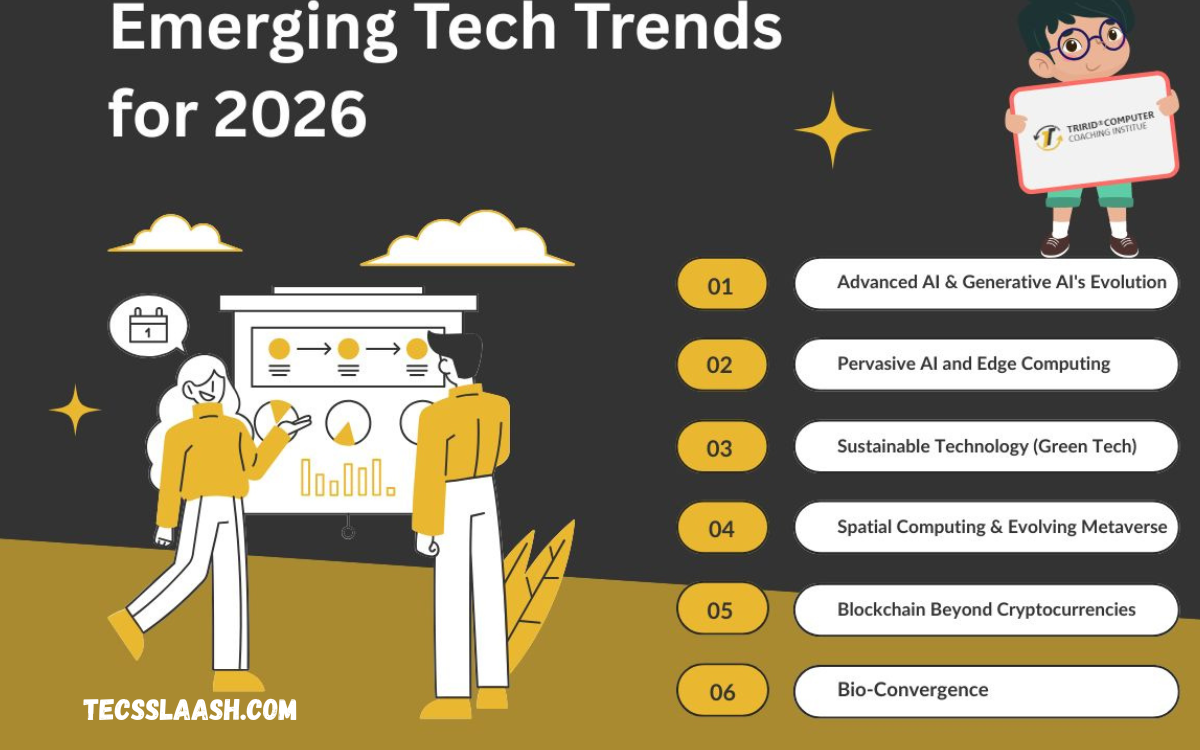
Emerging technology trends in 2026 are reshaping how people live, work, communicate, and do business. Rapid advances in artificial intelligence, automation, cybersecurity, cloud computing, robotics, and connected devices are creating new opportunities across industries.
Artificial intelligence remains one of the most influential trends in 2026, with businesses increasingly using AI for content creation, data analysis, customer service, software development, and decision-making. At the same time, edge computing and advanced cloud technologies are helping organizations process information faster while supporting real-time applications.
Artificial Intelligence and Intelligent Automation
Artificial intelligence remains one of the most significant technology developments in 2026. Businesses are using intelligent software to analyze information, automate repetitive activities, improve customer experiences, and support faster decision-making. These capabilities are becoming increasingly common across finance, healthcare, retail, manufacturing, education, and professional services.
Intelligent automation is also changing the workplace by combining software, data, and automated processes. Companies can streamline routine operations while employees concentrate on creative, strategic, and customer-focused responsibilities. As these systems become more practical, organizations are placing greater importance on responsible implementation, data quality, privacy, and human oversight.
Advanced Robotics and Automation
Robotics is moving beyond traditional industrial applications and becoming useful in warehouses, hospitals, agriculture, retail, construction, and other environments. Modern robots can perform repetitive tasks, transport materials, assist workers, and operate in locations where precision or consistency is especially important.
Automation is helping companies address productivity challenges while improving operational efficiency. In manufacturing and logistics, automated equipment can support faster production and more accurate inventory management. The growing combination of robotics, sensors, software, and connected systems is expected to create more flexible workplaces throughout 2026.
Quantum Computing Development
Quantum computing is another emerging area attracting attention in 2026. Unlike conventional computers, quantum systems use specialized methods of processing information that may eventually solve certain highly complex problems more efficiently. Research is progressing in areas such as materials science, chemistry, optimization, and advanced modeling.
Although large-scale quantum computing is still developing, organizations and researchers are preparing for its potential impact. Businesses are exploring possible applications while technology companies and research institutions continue working to improve reliability, scalability, and error management. Quantum technology could eventually influence industries that depend heavily on complex calculations.
Edge Computing and Faster Data Processing
Edge computing is becoming increasingly important as connected devices generate enormous amounts of information. Instead of sending every piece of data to a distant data center, edge systems process information closer to where it is produced. This approach can reduce delays and improve performance for applications requiring rapid responses.
The technology is particularly valuable for smart factories, connected vehicles, healthcare equipment, security systems, and Internet of Things applications. By combining edge computing with cloud infrastructure, organizations can create flexible systems that balance speed, storage, and centralized management while supporting increasingly connected environments.
Cybersecurity and Digital Protection
As technology adoption grows, cybersecurity has become a fundamental business requirement. Companies are strengthening their digital defenses to protect customer information, financial records, intellectual property, and internal systems from increasingly sophisticated threats. Security strategies in 2026 are focusing on prevention, continuous monitoring, identity protection, and rapid response.
Organizations are also paying greater attention to employee awareness and access management. Strong passwords, multi-factor authentication, secure networks, regular updates, and controlled permissions can reduce common security risks. Businesses that treat cybersecurity as an ongoing process rather than a one-time investment will be better positioned to protect their digital operations.
Cloud Computing and Digital Infrastructure
Cloud computing continues to support digital transformation in 2026. Businesses are using cloud platforms to store information, operate applications, collaborate remotely, and scale computing resources according to demand. Flexible infrastructure allows organizations to avoid relying entirely on expensive physical systems.
Hybrid and multi-cloud strategies are also becoming more common as companies seek greater flexibility and resilience. By combining different infrastructure environments, organizations can select suitable services for particular workloads. Cloud technology is therefore becoming an important foundation for modern businesses that need scalable and reliable digital operations.
Extended Reality and Immersive Experiences
Extended reality, including virtual reality and augmented reality, is creating new ways for people to interact with digital content. Businesses are exploring immersive experiences for training, product demonstrations, education, healthcare, entertainment, design, and customer engagement.
Improved devices and software are helping immersive technology become more practical and accessible. Instead of being limited to entertainment, these technologies can provide realistic simulations and interactive environments. In professional settings, immersive tools can help employees learn complex procedures safely and allow customers to experience products before making purchasing decisions.
Read Also: 25 Essential Laptop Accessories Every Student Needs in 2026
Sustainable and Green Technology
Sustainability is becoming an increasingly important part of technology development. Companies are investing in energy-efficient equipment, renewable energy systems, smarter buildings, efficient data centers, and technologies designed to reduce waste. These efforts can lower environmental impact while potentially reducing long-term operating costs.
Green technology is also supporting improvements in transportation, manufacturing, agriculture, and energy management. Smart monitoring systems can help organizations understand how resources are being consumed and identify areas for improvement. As environmental responsibilities become more important, sustainable technology will continue influencing business strategies throughout 2026.
Digital Healthcare and Medical Technology
Healthcare technology is evolving through connected devices, remote services, digital records, advanced diagnostics, and automated administrative systems. These developments can help healthcare providers manage information more effectively while giving patients greater access to convenient services.
Wearable devices and remote monitoring tools are also becoming valuable for tracking health-related information. Medical organizations are increasingly focused on secure data management and reliable digital infrastructure. As healthcare technology develops, the combination of better connectivity, advanced equipment, and improved information systems may contribute to more personalized and efficient care.
Internet of Things and Connected Devices
The Internet of Things continues to expand as more physical devices become connected to digital networks. Smart appliances, industrial equipment, vehicles, security systems, and wearable products can collect and exchange information, helping users monitor and control environments more efficiently.
Businesses are using connected devices to improve asset tracking, maintenance, inventory management, and operational visibility. Smart homes are also becoming more capable as connected lighting, security, appliances, and energy systems work together. However, increased connectivity also makes strong cybersecurity and privacy practices essential.
5G, Connectivity, and Next-Generation Networks
Faster and more reliable connectivity is supporting many of the Emerging Technology Trends in 2026. Advanced mobile networks can provide improved communication for smartphones, connected devices, industrial systems, and other digital applications. Reliable connectivity is particularly important for technologies that require rapid data exchange.
Improved networks are also supporting remote work, smart cities, connected transportation, and industrial automation. As connectivity expands, businesses can develop services that depend on real-time communication and distributed devices. Network performance will remain an important factor in the growth of connected technology.
Technology Trends Transforming Businesses
Technology is changing how organizations operate, communicate with customers, and compete in global markets. Businesses are adopting digital tools to automate processes, understand customer behavior, manage resources, improve collaboration, and create new services. Companies that successfully integrate useful technologies can gain efficiency and respond more quickly to market changes.
However, adopting every new technology is not always the best strategy. Businesses need to consider costs, security, employee skills, customer needs, compatibility, and long-term value before making investments. A clear technology strategy can help organizations choose practical solutions rather than following trends without a measurable purpose.
The Future of Technology in 2026
The technology landscape of 2026 is characterized by greater connectivity, automation, intelligent software, advanced computing, and sustainable innovation. Many technologies are developing together rather than operating independently. For example, connected devices can rely on edge computing, cloud platforms, advanced networks, and intelligent software to deliver more useful services.
The most successful organizations will likely be those that combine innovation with responsible planning. Technology can create significant opportunities, but businesses must also consider security, privacy, affordability, workforce development, and sustainability. A balanced approach can help ensure that technological progress delivers meaningful long-term value.
Frequently Asked Questions
What are the Emerging Technology Trends in 2026?
The major trends include intelligent automation, robotics, quantum computing, edge computing, cybersecurity, cloud technology, extended reality, sustainable technology, digital healthcare, connected devices, and advanced networks.
Why are technology trends important in 2026?
Technology trends help businesses understand changing customer expectations and new opportunities. They can also help organizations improve efficiency, security, communication, and competitiveness.
Which technology is growing fastest in 2026?
Intelligent software, automation, connected devices, cybersecurity, and cloud technologies are among the areas receiving significant attention. Growth varies by industry and geographic market.
How is automation changing businesses?
Automation can reduce repetitive manual work, improve consistency, accelerate processes, and allow employees to spend more time on higher-value responsibilities.
Is quantum computing ready for everyday use?
Quantum computing is still developing and is not yet a replacement for conventional computing. Its potential is strongest in specialized problems requiring advanced calculations and modeling.
Why is cybersecurity important in 2026?
Businesses depend heavily on digital systems and connected devices, making security essential for protecting sensitive information, financial assets, customers, and operations.
How does edge computing help businesses?
Edge computing processes information closer to where it is generated. This can reduce delays, improve responsiveness, and support applications that require fast data processing.
What role does cloud computing play in modern technology?
Cloud computing provides flexible access to storage, software, and computing resources. It helps businesses scale operations, support remote collaboration, and manage digital infrastructure.
Are sustainable technologies becoming more important?
Yes. Businesses are increasingly considering energy efficiency, renewable resources, waste reduction, and environmentally responsible infrastructure when planning technology investments.
How can businesses prepare for technology changes?
Businesses can prepare by monitoring relevant trends, upgrading digital skills, strengthening cybersecurity, reviewing infrastructure, and investing in technologies that solve specific operational or customer problems.
Conclusion
The Emerging Technology Trends in 2026 demonstrate how quickly digital innovation is influencing modern life and business. Intelligent automation, robotics, advanced computing, cloud infrastructure, cybersecurity, connected devices, immersive technology, and sustainable solutions are creating new possibilities across many industries.
The key is not simply adopting the newest technology but choosing solutions that provide measurable value.

