


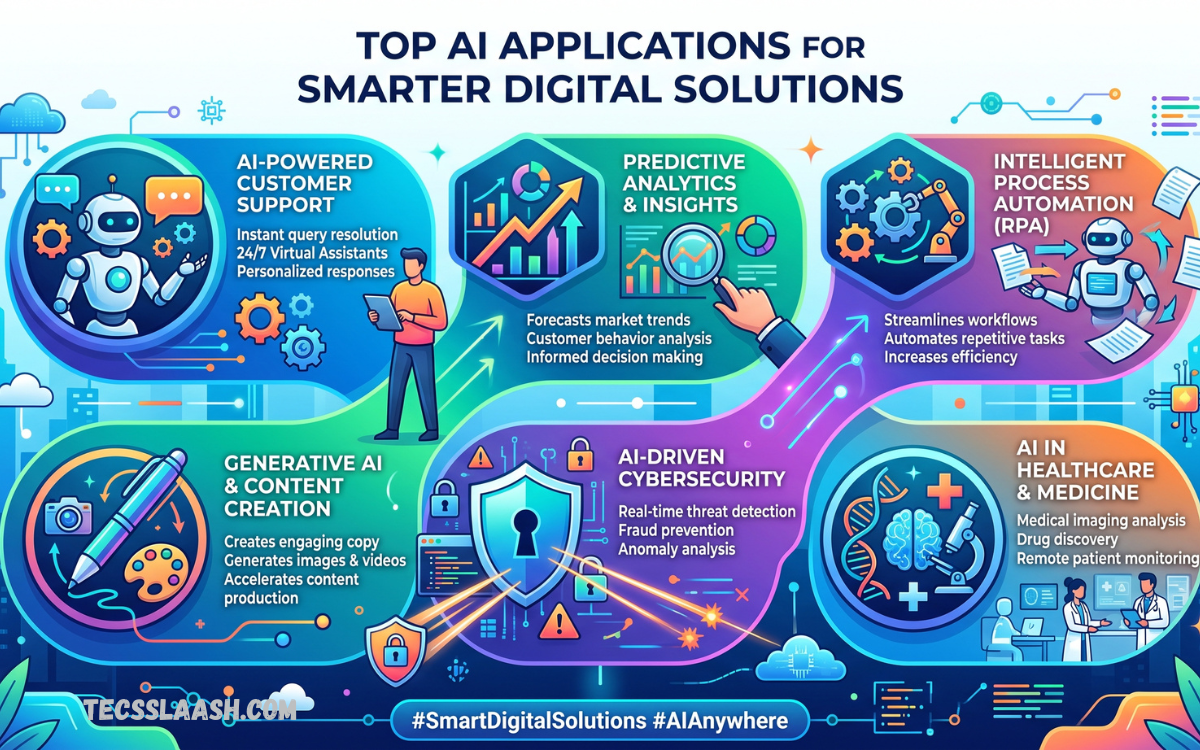
Artificial intelligence has become a practical technology for building faster, more efficient, and more intelligent digital solutions. Businesses are using AI to automate repetitive tasks, analyze large datasets, personalize customer experiences, improve security, and support better decision-making.
The Top AI Applications for Smarter Digital Solutions cover a broad range of capabilities, including conversational assistants, predictive analytics, recommendation engines, generative AI, intelligent automation, computer vision, cybersecurity, and personalized digital experiences.
AI-Powered Customer Support
AI-powered customer support is one of the most practical applications for modern digital businesses. Intelligent chatbots and virtual assistants can understand customer questions, provide instant answers, guide users through common processes, and transfer complex cases to human representatives when necessary.
Modern conversational systems can work with text, voice, and other forms of information, making customer interactions more natural and responsive. Businesses can provide support around the clock while reducing repetitive manual work.
Intelligent Business Automation
Intelligent automation combines AI with digital workflows to automate repetitive, rule-based activities more efficiently. Businesses can use it for document processing, data entry, invoice handling, scheduling, workflow management, and internal administrative operations.
Unlike traditional automation, AI-powered systems can interpret information and respond to changing circumstances. This makes them useful for processes where documents, requests, or decisions are not always presented in exactly the same format.
Predictive Analytics and Forecasting
Predictive analytics is another important part of the Top AI Applications for Smarter Digital Solutions. AI models can analyze historical information, current data, and emerging patterns to help businesses forecast future outcomes.
Companies can use predictive systems for sales forecasting, customer churn analysis, demand planning, inventory management, and operational planning. These capabilities help organizations make decisions based on evidence rather than relying entirely on assumptions.
Personalized Digital Experiences
Customers increasingly expect digital platforms to understand their interests and provide relevant experiences. AI enables businesses to personalize websites, applications, online stores, dashboards, recommendations, and marketing interactions based on user behavior and preferences.
Recommendation engines are a common example. They can analyze browsing activity, previous purchases, searches, and other signals to suggest products, services, articles, videos, or other content that may be relevant to individual users.
Generative AI for Content Creation
Generative AI has introduced new possibilities for creating text, images, audio, video, software code, summaries, and other digital materials. Organizations can use these capabilities to accelerate content production and support creative teams.
Marketing departments can use generative systems for campaign ideas, product descriptions, social media drafts, advertising concepts, and customer communications. Development teams can also use AI to assist with coding, documentation, testing, and software-related tasks.
AI-Powered Data Analysis
Modern businesses generate enormous quantities of information through websites, applications, transactions, customer interactions, and internal systems. AI can transform this information into useful insights by identifying patterns, classifying information, and summarizing complex datasets.
AI-powered analytics can help managers understand performance indicators, detect unusual activity, identify opportunities, and prioritize important business issues. Instead of spending hours reviewing large datasets manually, teams can use intelligent systems to surface the information that deserves attention.
Computer Vision Applications
Computer vision enables AI systems to interpret and analyze visual information, including photographs, videos, documents, and camera feeds. It is increasingly useful in manufacturing, retail, healthcare, logistics, security, and quality-control environments.
Businesses can use computer vision to identify objects, inspect products, read documents, monitor environments, and detect visual patterns. Automated inspection can help organizations identify defects more consistently and reduce the amount of repetitive visual checking performed by employees.
AI for Cybersecurity
Cybersecurity is becoming increasingly complex as organizations manage cloud platforms, mobile applications, connected devices, and large digital networks. AI can help security teams monitor activity and identify unusual behavior more quickly.
AI-based security systems can analyze large volumes of events and look for patterns associated with potential threats. They can help prioritize alerts, identify suspicious activity, and support security teams during incident investigations.
Read Also: Best Monitor Stands for an Ergonomic and Organized Desk Setup
AI in Healthcare and Professional Services
Healthcare and other professional industries can use AI to support decision-making, information processing, and personalized services. AI systems can analyze large datasets, assist with document processing, support research, and help professionals identify relevant information more efficiently.
In healthcare, AI applications can support areas such as medical image analysis, patient information management, research, and personalized treatment planning. The technology is generally most valuable when it assists qualified professionals rather than replacing professional judgment.
AI for Marketing and Sales
Marketing teams can use AI to understand audiences, identify trends, generate content ideas, analyze campaigns, and personalize communications. AI can process customer data and help businesses determine which messages, products, or offers may be most relevant to different audiences.
Sales teams can also use AI to prioritize leads, summarize customer interactions, identify potential opportunities, and automate routine communication. These capabilities allow sales professionals to spend more time developing relationships and handling complex negotiations.
AI-Powered Software Development
AI is changing the way software teams design, develop, test, and maintain applications. Development assistants can help programmers generate code, explain existing code, identify potential problems, create tests, and prepare technical documentation.
For businesses building digital products, these capabilities can shorten development cycles and help teams move from ideas to working prototypes more quickly. AI can also assist non-technical teams with early product concepts and workflow automation.
AI Agents and Autonomous Workflows
AI agents represent an important development in digital solutions because they can move beyond answering questions and assist with completing multi-step tasks. Agentic systems can interact with software tools, retrieve information, make decisions within defined boundaries, and perform workflow actions.
Businesses are exploring AI agents for customer service, finance, compliance, human resources, sales, and operational processes. Recent enterprise deployments show growing interest in connecting AI agents with existing business systems rather than using AI as an isolated tool.
Benefits of Smarter AI Digital Solutions
The major benefit of AI is not simply automation. It is the ability to combine automation, analysis, prediction, personalization, and intelligent decision support within digital workflows. This can help businesses improve productivity and respond to customers more quickly.
AI can also provide scalability. A digital system can analyze thousands of requests or records without requiring every task to be handled individually by a human employee. This can be particularly useful for growing organizations that need to expand services without increasing manual workloads at the same rate.
Challenges of AI Implementation
Despite its advantages, AI implementation requires careful planning. Poor-quality data can produce unreliable results, while unclear objectives can lead to expensive projects that provide little measurable value.
Privacy and security are also important considerations. Businesses should determine what information AI systems can access, how data is stored, who can use the system, and how sensitive information is protected.
How to Choose the Right AI Application
Businesses should begin by identifying a specific problem instead of adopting AI simply because it is popular. The best application is usually one that solves a measurable problem, improves an existing workflow, or creates a meaningful customer benefit.
Organizations should evaluate data availability, integration requirements, security, cost, scalability, and expected return on investment. A small pilot can provide valuable information before a company commits to a larger implementation.
Future of AI Digital Solutions
The future of AI will increasingly involve intelligent systems embedded directly into everyday applications. Rather than opening a separate AI tool, users may interact with AI capabilities inside customer platforms, productivity software, business applications, websites, and operational systems.
Multimodal AI is also expanding the way digital systems understand information. Combining text, voice, images, and other forms of data enables applications to provide richer, more natural interactions.
Frequently Asked Questions
What are the top AI applications for smarter digital solutions?
The top applications include AI chatbots, intelligent automation, predictive analytics, personalization, generative AI, computer vision, cybersecurity, data analysis, AI agents, and software development assistance.
How does AI improve digital business solutions?
AI improves digital solutions by automating repetitive work, analyzing large datasets, predicting outcomes, personalizing experiences, supporting decisions, and helping businesses respond faster to customers.
Is AI useful for small businesses?
Yes. Small businesses can use AI for customer support, content creation, marketing, scheduling, data analysis, lead management, and repetitive administrative tasks without necessarily requiring large internal technology teams.
Can AI reduce business operating costs?
AI can reduce costs by automating repetitive processes, improving productivity, reducing manual errors, and helping employees focus on higher-value responsibilities. Actual savings depend on the implementation and use case.
How does AI personalize customer experiences?
AI analyzes permitted customer signals such as preferences, interactions, browsing behavior, and purchase history to deliver more relevant recommendations, content, offers, or services.
What is generative AI used for?
Generative AI can create or transform text, images, audio, video, software code, summaries, and other digital materials. Businesses commonly use it for content, communication, research, development, and creative workflows.
Are AI applications secure?
AI applications can be secure when they are designed with appropriate access controls, data protection, monitoring, testing, and governance. Security depends heavily on implementation and the information being processed.
Can AI replace human employees?
AI can automate certain tasks, but many organizations use it to augment employees rather than completely replace them. Human judgment remains particularly important for complex, sensitive, creative, and high-impact decisions.
What should a business consider before adopting AI?
A business should consider its specific objectives, data quality, security requirements, integration needs, costs, scalability, employee capabilities, regulatory obligations, and measurable return on investment.
What is the future of AI applications?
The future will likely include more intelligent agents, multimodal systems, personalized applications, predictive services, automated workflows, and AI capabilities embedded directly into everyday digital platforms.
Conclusion
The Top AI Applications for Smarter Digital Solutions demonstrate how artificial intelligence is becoming a practical foundation for modern digital transformation. From customer support and automation to predictive analytics, personalization, cybersecurity, generative AI, and intelligent agents, businesses can apply AI to solve real operational and customer-facing challenges.
The most successful AI strategies will not simply focus on adopting the newest technology. They will connect AI capabilities to clear business objectives, reliable data, strong security, responsible governance, and measurable outcomes

