


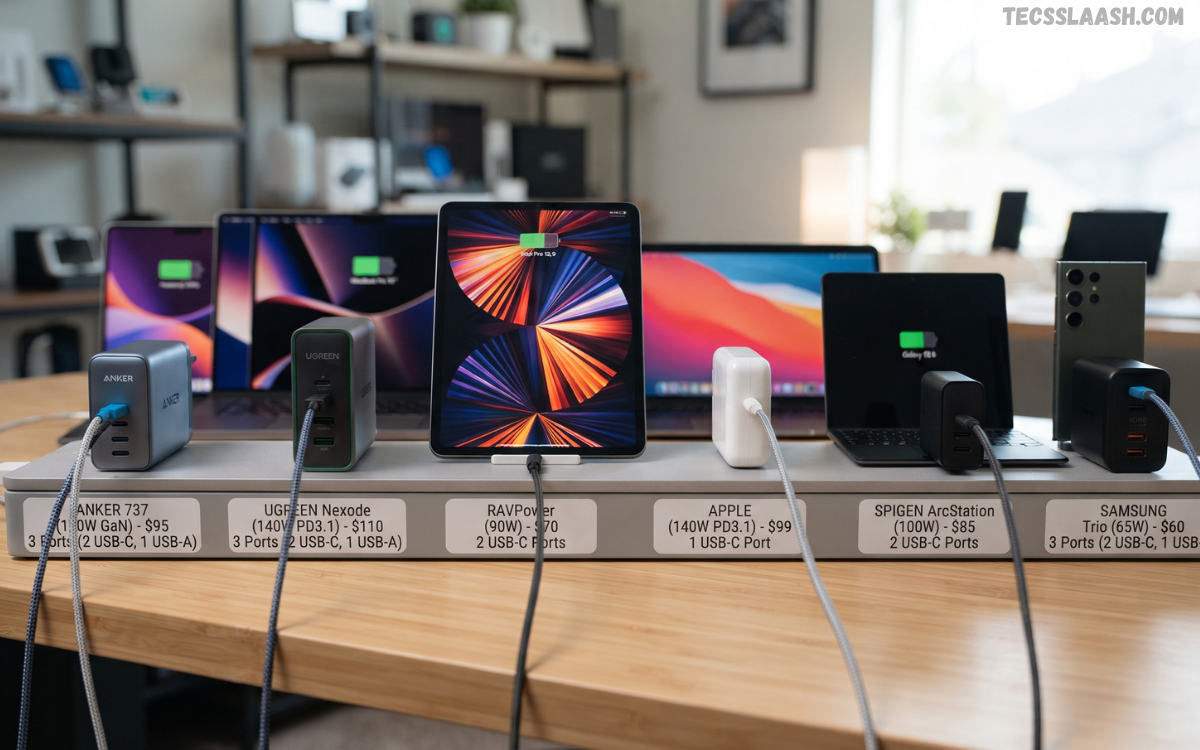
Fast charging has become an important feature for modern smartphones, tablets, laptops, earbuds, gaming devices, and other portable electronics. A good charger can restore a significant amount of battery power within a short period, reducing waiting time and making everyday device use more convenient.
This Best Fast Chargers Compared guide examines the most important factors behind modern charging performance, including power output, USB-C Power Delivery, PPS support, charging ports, cable compatibility, safety technology, size, efficiency, and overall value.
What Makes a Fast Charger Different?
A fast charger delivers electrical power to a compatible device at a higher rate than a conventional low-power adapter. Charging speed depends on several factors, including charger wattage, device charging limits, charging protocol, cable capability, battery temperature, and the current battery level.
Modern fast chargers commonly use technologies such as USB Power Delivery and Programmable Power Supply. USB Power Delivery allows compatible devices and chargers to negotiate an appropriate power level, while PPS can provide more flexible voltage and current adjustment on supported devices.
Best Fast Chargers Compared by Power Output
Power output represents the maximum electrical power a charger can potentially provide. Common charger categories include 20W, 30W, 45W, 65W, 100W, and higher-capacity models.
Higher wattage is useful when charging multiple devices or power-hungry equipment, but maximum wattage should not be the only purchasing factor.
Best Fast Chargers Compared for Smartphones
Smartphone users generally benefit from chargers that combine compact dimensions, reliable power delivery, and broad protocol support. A charger around 25W to 45W can provide strong performance for many modern phones, while some flagship devices support higher proprietary or USB-C charging speeds.
A charger with USB-C Power Delivery and PPS support can offer particularly broad compatibility across modern smartphones. PPS is especially relevant for devices that use adaptive charging systems.
Best Fast Chargers Compared for iPhones
Recent iPhones use USB-C, making USB-C Power Delivery chargers a practical choice for wired fast charging. Users typically do not need extremely high-wattage laptop chargers simply to charge an iPhone efficiently.
When selecting an iPhone charger, look beyond the wattage printed on the packaging. A quality USB-C PD charger from a reputable manufacturer can provide stable power while incorporating protections against excessive current, voltage, temperature, and short circuits.
Best Fast Chargers Compared for Android Phones
Android charging requirements vary considerably between manufacturers and individual models. Some phones use USB Power Delivery, while others support PPS or proprietary high-speed charging technologies.
For broad Android compatibility, USB-C PD with PPS can be a strong choice when the phone supports those standards. Users seeking maximum proprietary charging speeds should check the specifications provided for their exact smartphone.
Best Fast Chargers Compared for Tablets
Tablets usually require more power than smartphones because they have larger batteries and displays. A 30W to 45W charger can be sufficient for many tablets, while larger premium tablets may benefit from higher-power adapters.
A multi-port charger can be particularly convenient for tablet owners who also carry a smartphone, earbuds, smartwatch, or other accessories. However, users should check how the charger’s total output is distributed between ports.
Best Fast Chargers Compared for Laptops
USB-C charging has transformed laptop charging by allowing many compatible notebooks to use relatively compact power adapters. Laptop requirements can range from approximately 30W for lightweight systems to 65W, 100W, or higher for more demanding machines.
A 65W USB-C charger can be a practical solution for many productivity laptops, while higher-powered models can be useful for compatible performance-oriented systems. When purchasing a laptop charger, verify the required USB-C Power Delivery profile, maximum input power, and cable rating.
Best Fast Chargers Compared: Single-Port vs Multi-Port
Single-port chargers provide a straightforward charging experience because their entire available output is dedicated to one connected device. They are useful for users who primarily charge one smartphone, tablet, or laptop at a time. Single-port designs can also be smaller and easier to carry.
Multi-port chargers provide greater flexibility for households, offices, travel, and workspaces containing several USB-powered devices. A multi-port GaN charger can potentially replace several separate adapters.
GaN Technology and Fast Charging
Gallium nitride, commonly called GaN, has become increasingly popular in compact charging hardware. GaN semiconductors can operate efficiently at high switching frequencies, allowing manufacturers to create smaller power adapters while maintaining substantial power output.
The main advantage of a GaN charger is not automatically faster charging. Charging speed remains dependent on the connected device and supported charging protocol.
Charging Speed and Real-World Performance
Advertised wattage represents potential power delivery rather than a guaranteed charging speed throughout an entire charging session. Batteries typically accept different power levels depending on their current charge percentage, temperature, battery condition, and software-controlled charging strategy.
Real-world charging performance also depends on whether the charger and device support the same protocol. A powerful charger can still charge a device slowly if the required charging standard is unavailable.
USB-C Power Delivery Explained
USB Power Delivery, commonly abbreviated USB PD, is a widely used charging standard designed to negotiate power between compatible devices and chargers. It supports multiple voltage and power configurations, allowing the same charger to serve different categories of electronics.
One major advantage of USB PD is versatility. A single compatible charger can potentially power a smartphone during the morning, a tablet during the afternoon, and a laptop during the evening.
PPS Support and Why It Matters
Programmable Power Supply, or PPS, is an extension associated with USB Power Delivery that allows compatible chargers to adjust voltage and current more dynamically. Instead of relying only on fixed voltage levels, PPS-compatible systems can make finer adjustments during charging.
PPS compatibility is particularly relevant when choosing chargers for certain Android smartphones. A charger can support USB PD but lack PPS, meaning it may not provide the same charging behavior as a charger supporting both standards.
Why the Charging Cable Matters
The charger is only one part of the charging system. The cable also has electrical limits that can affect performance, especially with higher-power USB-C charging.
For everyday smartphone charging, a quality USB-C cable from a reliable manufacturer is generally sufficient when its specifications match the charger and device. For 100W-class or higher USB-C charging, users should pay closer attention to the cable’s power rating.
Fast Charger Safety Features
A quality fast charger should include multiple protection mechanisms designed to manage electrical and thermal conditions. Common protections include over-voltage protection, over-current protection, short-circuit protection, over-temperature protection, and power regulation.
Charger quality matters because the adapter converts electrical power from an outlet into a form suitable for electronic devices. Extremely cheap or poorly manufactured adapters may lack appropriate certification or protective circuitry.
Charger Size and Portability
Traditional high-power chargers can be relatively large, which makes them inconvenient for travel and daily carrying. GaN technology has enabled many manufacturers to reduce charger dimensions while maintaining high power output.
Travel users should consider more than physical size. A charger with folding prongs, multiple ports, broad voltage compatibility, and sufficient power can reduce the number of accessories required during a trip. A compact 65W or 100W multi-port charger may replace separate adapters for several compatible devices.
Best Fast Chargers Compared for Travel
Travel charging often requires flexibility because users may carry multiple devices with different power requirements. A multi-port USB-C charger can reduce luggage space by replacing individual phone, tablet, and laptop adapters.
Before traveling internationally, check the charger’s input voltage range and the plug configuration required at the destination. A USB-C charger with broad input support can work across many electrical systems when paired with the appropriate plug adapter.
Charging Multiple Devices at Once
Multi-device charging introduces power-sharing considerations. For example, a charger may advertise 100W total output but divide that capacity among several ports when multiple devices are connected. Connecting a laptop and smartphone simultaneously can therefore change the amount of power available to each device.
Port layout also matters. Some chargers include dedicated high-power USB-C ports alongside lower-power USB-A ports. Understanding the output profile helps users connect each device to the most appropriate port.
Compact Chargers vs High-Power Chargers
Compact chargers prioritize portability and are often designed for smartphones, tablets, and lightweight electronics. Their smaller physical size makes them convenient for school, work, travel, and everyday carrying.
High-power chargers are better suited to users who need to charge laptops, tablets, phones, and other equipment from one adapter. They are often slightly larger but can reduce the need to carry multiple chargers.
How to Choose the Right Fast Charger
Start by identifying the highest charging requirement among the devices you regularly use. If the primary device requires 30W, purchasing an extremely high-power adapter may provide little practical benefit unless you also intend to charge a laptop or several devices.
Next, check protocol compatibility, number of ports, cable requirements, physical dimensions, and safety features. USB-C PD is useful for broad compatibility, while PPS can provide additional benefits for supported devices.
Common Fast-Charger Buying Mistakes
One common mistake is assuming that higher wattage always means faster charging. The connected device determines how much power it can accept, and charging protocols control how that power is delivered.
Another mistake is ignoring the cable. A charger capable of high-power USB-C output requires a suitable cable when operating near its maximum capability. Buyers should also avoid choosing unfamiliar products based only on low prices.
Read Also: Money Heist Release Dates and Season Premiere Timeline
Fast Charging and Battery Longevity
Fast charging generates heat, and temperature management plays an important role in battery performance. Modern smartphones use software and hardware controls to manage charging speed, temperature, and battery conditions.
Users can support healthy charging behavior by avoiding excessive heat during charging and using compatible, reliable accessories. There is no need to select an unnecessarily powerful charger for a device that does not support that power level.
Best Fast Chargers Compared for Everyday Use
For everyday smartphone users, a compact USB-C charger with appropriate PD support can provide a practical combination of speed and portability. Users who carry tablets or laptops may benefit from moving to a 65W-class charger, particularly when one adapter can cover several devices.
The best everyday setup depends on the devices being charged rather than a universal wattage target. A smartphone-focused user may prioritize a small adapter, while a laptop user may prioritize higher output and multiple USB-C ports.
Best Fast Chargers Compared for Work and Home
A home charging station benefits from a charger that can handle several devices without requiring multiple power adapters. A multi-port GaN charger can provide a cleaner setup for smartphones, tablets, laptops, earbuds, and other compatible electronics.
For an office or desk environment, port placement and cable management can be just as important as wattage. A charger with multiple USB-C ports can reduce clutter and make it easier to connect different devices.
Best Fast Chargers Compared for Students
Students often prioritize portability, affordability, and compatibility. A compact 30W or 45W USB-C charger can be suitable for many phones and tablets, while students using USB-C laptops may benefit from a 65W model.
Durability also matters for frequently transported accessories. A sturdy charger with reliable connectors and a quality cable can withstand regular movement better than poorly manufactured alternatives.
Best Fast Chargers Compared for Gamers
Gaming devices can have higher power requirements, particularly handheld gaming systems and gaming laptops. USB-C PD chargers with sufficient output can provide useful flexibility for compatible handheld devices.
Gamers who travel with multiple devices can benefit from a high-output multi-port charger. However, simultaneous charging can reduce available power per port.
Are Expensive Fast Chargers Worth It?
Price alone does not determine charging performance. A premium charger may offer advantages such as better thermal management, GaN technology, more ports, higher power output, stronger build quality, broader compatibility, and longer warranty support. These features can justify a higher price when they match the user’s requirements.
At the same time, users do not need the most expensive charger for basic smartphone charging. A reputable mid-range charger with appropriate USB-C PD support can provide excellent everyday functionality.
How to Read Fast-Charger Specifications
Charger packaging can contain several numbers and technical terms, including input voltage, output voltage, current, total wattage, PD profiles, PPS ranges, and port-specific limits.
Pay particular attention to USB-C output information. A charger may have several ports but provide different power levels through each one.
Future of Fast Charging
Charging technology continues to move toward higher power density, smaller adapters, improved thermal management, and greater interoperability. USB-C has become an important common interface across many categories of electronics, reducing the need for device-specific charging hardware.
Higher wattage will likely remain useful for laptops and other power-hungry electronics, but intelligent power management matters just as much.
Frequently Asked Questions
What is the best wattage for a fast charger?
The ideal wattage depends on the device. Many smartphones work well with 20W to 45W chargers, while tablets and laptops may require 45W, 65W, 100W, or more.
Does a higher-wattage charger charge every device faster?
No. A device only accepts the amount of power supported by its charging system. A higher-wattage charger does not automatically increase charging speed.
What is USB Power Delivery?
USB Power Delivery, or USB PD, is a charging standard that allows compatible devices and chargers to negotiate suitable power levels for efficient charging.
Is GaN technology useful in fast chargers?
Yes. GaN technology allows manufacturers to produce compact chargers capable of delivering relatively high power while maintaining efficient operation.
Does the charging cable affect charging speed?
Yes. The cable must support the required power level and charging standard. An unsuitable cable can limit the performance of a high-power charger.
Is PPS important for Android phones?
PPS can be important for Android devices that support the standard. It enables more flexible power adjustment and can improve charging performance on compatible phones.
Can one fast charger charge multiple devices?
Yes. Multi-port chargers can charge several compatible devices simultaneously. However, the available power may be divided between ports.
Are fast chargers safe for smartphones?
Quality fast chargers include protections against conditions such as excessive current, voltage, temperature, and short circuits. Using compatible, reputable charging accessories is recommended.
Can a fast charger damage a phone battery?
Modern devices use charging controls to regulate power and temperature. Using a compatible, quality charger is generally preferable to using poorly manufactured charging equipment.
How do I choose the right fast charger?
Check your device’s required wattage, supported charging protocols, cable requirements, number of ports, safety features, size, and intended use before purchasing a charger.
Conclusion
Don’t choose the best fast charger based solely on the highest wattage. Instead, consider the complete charging system: device requirements, USB-C PD support, PPS compatibility, cable rating, port configuration, safety protections, size, and power distribution.
For smartphone-focused users, a compact USB-C PD charger can be sufficient, while users with tablets and laptops may benefit from 65W or higher output. Multi-port GaN chargers can provide a convenient solution for households, offices, and travelers with several devices.

