


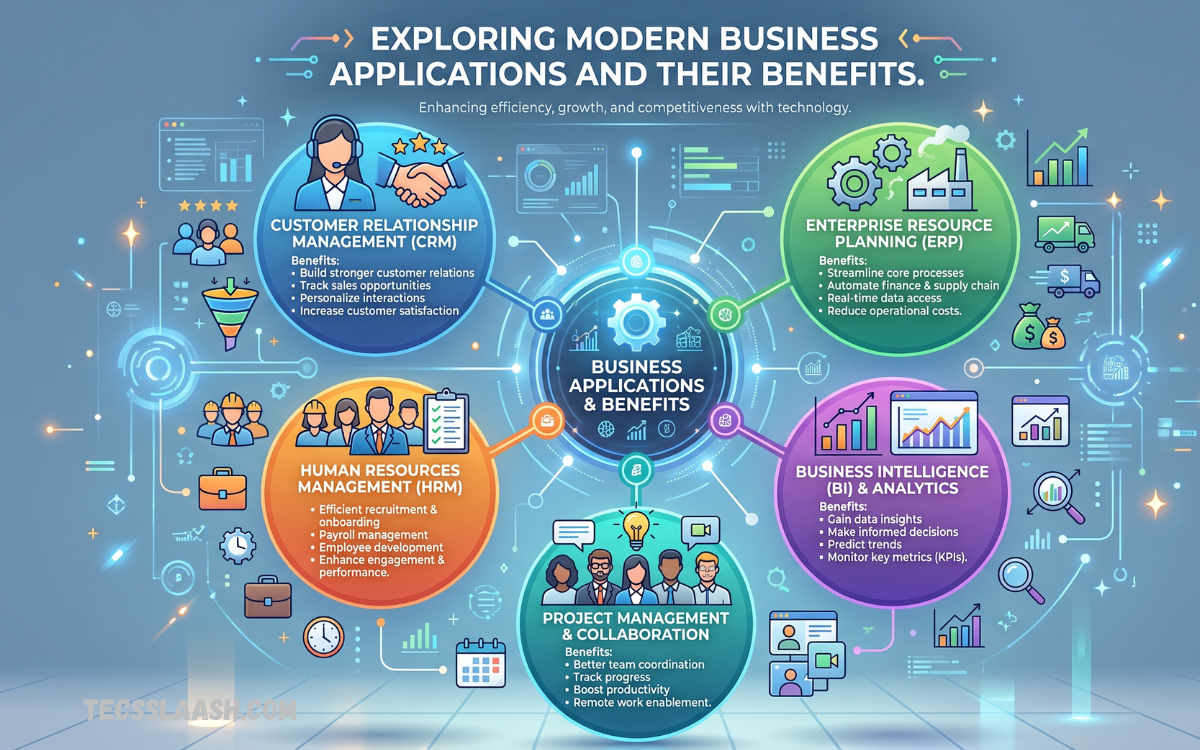
Business applications have become an essential part of modern organizations because they help companies manage daily activities more quickly and accurately. From accounting and customer management to communication and project planning, these applications support important business functions.
The growing use of digital technology has changed how companies operate, communicate, and serve customers. Businesses of every size can use the right applications to simplify complicated processes, improve employee performance, and make better decisions based on reliable information.
What Are Business Applications?
Business applications are software programs designed to help organizations perform specific tasks and manage different business operations. They can be used for accounting, sales, marketing, human resources, inventory, customer service, communication, and many other activities.
These applications replace many manual processes with organized digital systems. Instead of maintaining separate spreadsheets, paper records, or disconnected tools, businesses can manage critical information through centralized applications that streamline workflows and improve efficiency.
Why Businesses Need Applications?
Modern businesses handle large amounts of information every day, making manual management increasingly difficult. Business applications provide structured ways to store, organize, update, and access information whenever it is required.
They also help employees complete repetitive tasks more quickly and reduce unnecessary administrative work. When routine processes are automated, employees can spend more time on customer service, planning, problem-solving, and other activities that contribute directly to business growth.
Improved Business Productivity
One of the most important benefits of business applications is improved productivity. Employees can use specialized tools to complete tasks faster, monitor progress, communicate with colleagues, and manage their responsibilities from a single platform.
Automation can also reduce the time required for repetitive activities such as data entry, reporting, scheduling, and document management. This allows businesses to accomplish more without increasing the workload on employees.
Better Communication and Collaboration
Effective communication is essential for every successful organization. Business applications provide communication platforms that allow employees to exchange messages, share documents, organize meetings, and collaborate on projects without relying entirely on traditional communication methods.
Cloud-based applications make collaboration even more convenient because employees can access information from different locations and devices. Teams can work together on projects while maintaining better visibility of responsibilities, deadlines, and important updates.
Efficient Customer Relationship Management
Customer relationship management applications help businesses organize customer information and improve interactions. Sales teams can track leads, customer inquiries, previous communications, purchases, and follow-up activities in one organized system.
Better access to customer information enables companies to provide more personalized service. Employees can understand customer requirements more effectively, respond to questions quickly, and develop stronger relationships that can encourage repeat business.
Accurate Financial Management
Financial applications help organizations manage invoices, expenses, payments, budgets, payroll, and financial reports. These tools can reduce the possibility of mistakes that may occur when financial records are handled manually.
Businesses can also monitor their financial position more effectively through organized reports and dashboards. Accurate financial information helps management understand expenses, revenue, cash flow, and overall performance before making important decisions.
Simplified Project Management
Project management applications help teams organize tasks, assign responsibilities, monitor deadlines, and track project progress. Managers can see which activities have been completed and which tasks require additional attention.
These tools can make complex projects easier to manage by keeping important information in one location. Better organization can reduce delays, improve accountability, and help teams complete projects on schedule.
Better Data Management
Data has become one of the most valuable resources for modern organizations. Business applications provide systems for collecting, organizing, storing, and accessing business information in a structured manner.
Good data management helps employees find the information they need without wasting time searching through multiple files. It can also improve consistency and reduce the risks associated with duplicate, outdated, or incorrectly entered information.
Automation of Routine Tasks
Automation is another major advantage of business applications. Many applications can automatically perform repetitive activities such as sending notifications, generating reports, processing transactions, updating records, and managing schedules.
Automating routine processes saves time and reduces human involvement in tasks that do not require complex decision-making. This can increase operational efficiency while allowing employees to concentrate on more valuable responsibilities.
Reduced Operating Costs
Business applications can help companies reduce operating expenses by improving resource utilization and minimizing unnecessary manual work. Automated workflows can reduce the time employees spend on repetitive administrative tasks.
Digital systems may also reduce dependence on physical paperwork, manual record keeping, and multiple disconnected tools. Over time, these improvements can contribute to lower operational costs and better use of available business resources.
Improved Decision-Making
Business leaders need accurate information when making strategic decisions. Business applications can collect information from different departments and present useful reports, dashboards, and performance indicators.
With better visibility into business activities, managers can identify trends, recognize problems, evaluate performance, and plan future strategies more confidently. Data-driven decision-making can reduce dependence on assumptions and incomplete information.
Enhanced Employee Management
Human resource applications help businesses manage employee information, attendance, recruitment, payroll, performance, and other workforce activities. Centralizing employee records can make administrative responsibilities more organized.
Employees can also benefit from self-service features that allow them to access relevant information, submit requests, or update certain records. This can reduce administrative pressure on human resource departments while improving employee convenience.
Inventory and Supply Chain Management
Inventory applications help businesses monitor products, stock levels, orders, suppliers, and movement of goods. Accurate inventory information is particularly important for companies that sell physical products or manage large quantities of materials.
Better inventory control can help organizations avoid excessive stock and unexpected shortages. Businesses can make purchasing decisions based on current information, improve order management, and provide customers with more reliable product availability.
Read Also: Best AI Video Generator for Professional Video Creation
Stronger Marketing Activities
Marketing applications help companies plan campaigns, manage customer information, monitor engagement, and evaluate marketing performance. They can bring different marketing activities together and provide useful information about campaign results.
Businesses can use these insights to understand which strategies are performing well and where improvements are necessary. Better marketing management can help organizations use their resources more effectively and reach suitable audiences.
Increased Business Security
Business applications can provide security features designed to protect important organizational information. Depending on the application, these features may include user permissions, authentication, backups, access controls, and activity monitoring.
Security becomes especially important when companies store financial records, customer information, employee details, and confidential business documents digitally. Proper application management and security practices can help reduce unauthorized access and information loss.
Scalability for Growing Businesses
A major advantage of modern business applications is their ability to support organizational growth. A company may begin with a small number of employees and customers but eventually require more advanced systems as operations expand.
Scalable applications can accommodate increasing workloads, users, transactions, and data requirements. Choosing technology that can grow with the organization helps businesses avoid replacing their systems whenever their operational needs change.
Cloud-Based Business Applications
Cloud-based applications allow businesses to access software and information through internet-connected devices. This approach can provide greater flexibility for organizations with remote employees, multiple offices, or teams that frequently work outside traditional workplaces.
Cloud solutions can also simplify software updates, data accessibility, and collaboration. However, businesses should carefully evaluate security, reliability, privacy, support, and access requirements before selecting a cloud-based application.
Choosing the Right Business Application
Selecting the right application requires a clear understanding of business goals and operational requirements. Companies should evaluate the features they actually need rather than choosing software simply because it offers a large number of features.
Important factors can include ease of use, scalability, security, integration, cost, customer support, reliability, and compatibility with existing systems. A suitable application should solve real business problems and provide measurable value to the organization.
Challenges of Business Applications
Although business applications offer many benefits, implementation can also create challenges. Employees may need training, existing data may need to be migrated, and organizations may face temporary disruption as new systems are introduced.
Businesses should therefore develop a clear implementation strategy before adopting new software. Employee training, testing, technical support, data protection, and regular system evaluation can help organizations achieve better results.
Future of Business Applications
The future of business applications is expected to focus increasingly on automation, intelligent analytics, cloud technology, integration, and personalized user experiences. Organizations are looking for tools that can provide useful information while reducing unnecessary manual effort.
As technology continues to develop, businesses will have more opportunities to connect their departments and create efficient digital workflows. Organizations that select technology carefully and adapt to changing requirements can strengthen their competitiveness in a rapidly evolving marketplace.
Frequently Asked Questions
What are business applications?
Business applications are software tools created to support specific business activities such as accounting, sales, marketing, customer management, human resources, communication, and project management.
How do business applications improve productivity?
They improve productivity by automating repetitive tasks, organizing information, simplifying workflows, and helping employees complete their responsibilities more efficiently.
Can small businesses use business applications?
Yes, small businesses can benefit significantly from business applications. Affordable and scalable solutions can help small organizations manage customers, finances, projects, inventory, and communication.
Do business applications reduce costs?
Business applications can reduce costs by automating manual processes, reducing paperwork, improving resource management, and saving employees time on repetitive administrative activities.
Are business applications useful for remote teams?
Yes, many modern applications support remote collaboration by allowing employees to communicate, share files, manage projects, and access business information from different locations.
How do business applications help customers?
They help businesses maintain organized customer records, respond to inquiries faster, track interactions, personalize services, and provide more consistent customer support.
Are cloud-based business applications secure?
Cloud applications can include strong security features, but security depends on the provider, configuration, access controls, and the organization’s own security practices. Businesses should evaluate security carefully before adoption.
How do applications support business decisions?
Applications can organize operational information and provide reports, dashboards, and performance data. This information helps managers identify trends and make decisions based on more reliable business information.
What should a business consider before choosing an application?
Businesses should consider cost, features, usability, security, scalability, integration, reliability, customer support, and whether the application effectively addresses their specific operational requirements.
Can business applications support future growth?
Yes, scalable applications can support increasing numbers of employees, customers, transactions, and business activities. Selecting a flexible solution can make future expansion easier and more efficient.
Conclusion
Business Applications and Their Benefits are closely connected to the way modern organizations improve productivity, manage information, communicate with customers, and control daily operations. The right applications can simplify complicated processes and provide employees with the tools they need to perform effectively.
From financial management and customer relationships to automation, security, and decision-making, business applications can support almost every major area of an organization.

