


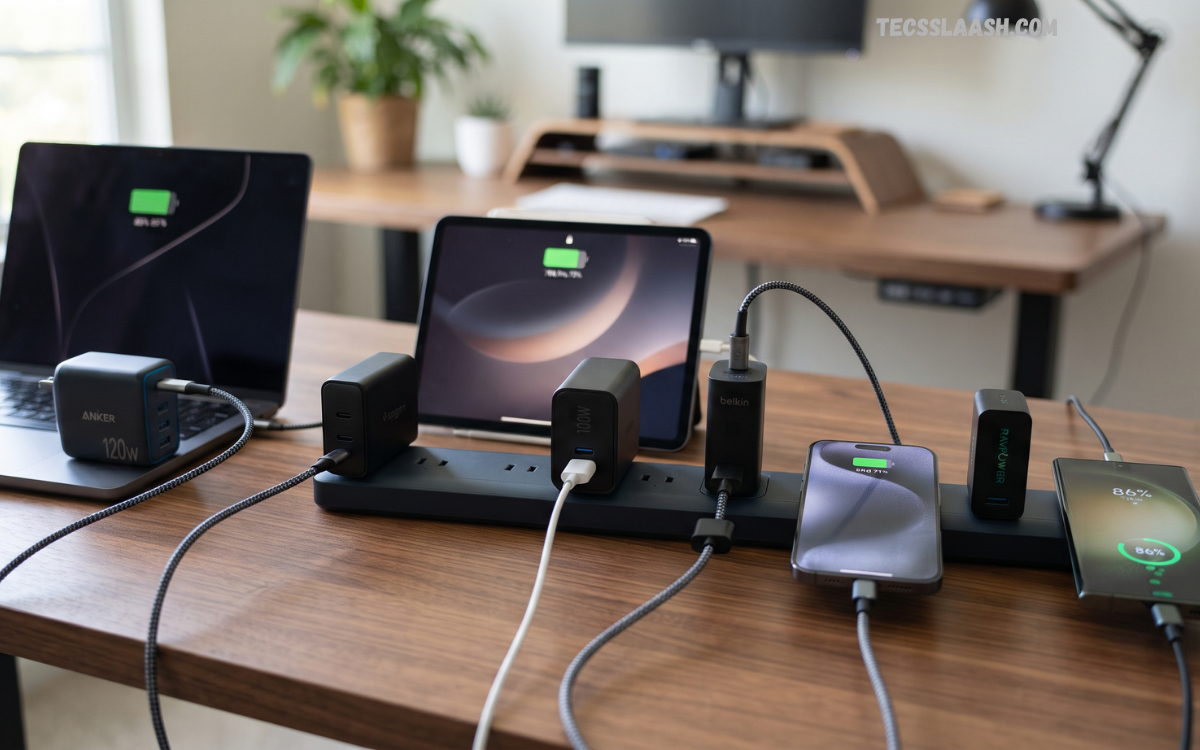
Finding the Best Fast Chargers can make everyday device use significantly more convenient. Modern smartphones, tablets, laptops, earbuds, smartwatches, gaming accessories, and other electronics increasingly support faster charging technologies. A suitable fast charger can restore a substantial amount of battery power quickly, reducing the time spent connected to a wall outlet.
A high-quality charger should deliver the power a device can safely accept without creating unnecessary heat or instability. Different manufacturers also use different charging standards, meaning a charger with a high wattage rating may not always provide maximum speed with every device.
What Are Fast Chargers?
Fast chargers are power adapters designed to deliver electricity at higher rates than conventional standard chargers. Charging performance generally depends on a combination of voltage, current, device compatibility, charging protocol, battery-management technology, and cable capability.
Modern fast-charging systems can dynamically adjust power delivery according to battery temperature, charge level, and device requirements. During the early stage of charging, a compatible device may accept higher power before gradually reducing the charging rate as the battery approaches full capacity.
Why Choose the Best Fast Chargers?
The biggest advantage of the Best Fast Chargers is reduced charging time. A capable charger can provide enough energy during a short break, commute, meeting, or travel stop to keep a smartphone operational for many additional hours. This becomes particularly useful for people who depend heavily on mobile devices throughout the day.
Quality also matters because chargers remain connected to valuable electronics for extended periods. A well-designed charger can include protections against overcurrent, overvoltage, overheating, and short circuits. Choosing a reputable charger with appropriate safety features can provide a better combination of performance, reliability, and long-term usability than purchasing a low-quality adapter based only on its advertised wattage.
USB-C Power Delivery
USB-C Power Delivery, commonly known as USB PD, is one of the most important charging technologies available today. It enables compatible chargers and devices to negotiate an appropriate power level instead of simply delivering a fixed amount of electricity. USB PD is widely used across smartphones, tablets, laptops, handheld gaming devices, power banks, and other electronics.
A USB-C PD charger can therefore serve multiple purposes. One compact adapter may charge a smartphone during the day and provide enough power for a compatible laptop later. When selecting a USB-C PD model, buyers should check the charger’s maximum output and confirm that the connected device supports the required charging standard.
GaN Technology and Fast Chargers
Gallium nitride, commonly called GaN, has become an important technology in modern charging adapters. GaN components can operate efficiently at high switching frequencies, allowing manufacturers to create smaller and more efficient power supplies. This is especially useful for people who want high charging performance without carrying a large traditional adapter.
The compact design of GaN chargers makes them particularly attractive for travel and professional use. A single multi-port GaN charger can potentially replace several conventional adapters while maintaining high power output. Buyers should still examine thermal performance, port distribution, maximum combined output, and manufacturer reputation rather than choosing a charger solely because it uses GaN technology.
Best Fast Chargers for Smartphones
The Best Fast Chargers for smartphones should match the phone’s supported charging technology. A high-output adapter does not automatically make every smartphone charge at the same maximum speed. The phone, charger, charging protocol, and cable must work together for optimal performance.
For everyday smartphone charging, a USB-C PD charger with an appropriate wattage rating is often a versatile choice. Some smartphones also support proprietary charging systems that can provide higher speeds when paired with a compatible manufacturer-specific adapter. Checking the phone manufacturer’s specifications before buying can prevent unnecessary spending on power output the device cannot use.
Best Fast Chargers for iPhones
iPhones with USB-C charging ports can benefit from compatible USB-C Power Delivery chargers. The exact charging behavior depends on the iPhone model, charger, cable, battery condition, and other factors. A quality USB-C PD adapter can also provide useful compatibility with other USB-C devices.
When choosing a fast charger for an iPhone, buyers should focus on reliability, USB-C output, appropriate power delivery, and cable quality. Purchasing an extremely high-wattage adapter is not necessarily beneficial if the phone cannot utilize the additional power. A well-built charger with broad device compatibility can offer greater value over time.
Best Fast Chargers for Samsung Phones
Samsung Galaxy smartphones support various fast-charging technologies depending on the model. Some devices support USB Power Delivery with additional charging capabilities, while others have different maximum charging requirements. Buyers should therefore verify the exact charging specifications of their Galaxy device before selecting an adapter.
A charger with sufficient USB-C output and compatible charging standards can be a strong choice for Samsung users. Multi-port models are also useful for people who charge a Galaxy smartphone alongside wireless earbuds, a tablet, smartwatch, or other accessories. Selecting a charger with enough total output is important when multiple devices are connected simultaneously.
Best Fast Chargers for Android Devices
Android devices vary considerably in charging requirements. Some models emphasize USB PD compatibility, while others rely on proprietary charging systems developed by individual manufacturers. Charging speeds can therefore differ substantially between phones even when the same adapter is used.
The safest approach is to identify the phone’s maximum supported charging speed and required protocol before purchasing. A versatile USB-C charger can still be useful when maximum proprietary charging is not required because it can support numerous other electronics. Buyers should prioritize compatibility rather than choosing the highest wattage available.
Best Fast Chargers for Laptops
Fast charging is no longer limited to smartphones. Many modern laptops use USB-C for both charging and data connectivity. Depending on the laptop, power requirements can range from relatively modest levels to substantially higher outputs, especially for performance-oriented systems.
For laptop charging, the Best Fast Chargers should provide enough sustained wattage for the computer. A charger that is adequate for a smartphone may not be powerful enough for a laptop. Buyers should check the laptop manufacturer’s recommended adapter output and choose a charger that meets or exceeds the required specification while maintaining compatibility with USB PD or the laptop’s supported charging system.
Best Multi-Port Fast Chargers
Multi-port chargers are excellent for households, offices, and travelers who regularly charge several devices. Instead of carrying separate adapters for a phone, tablet, laptop, earbuds, and other accessories, users can connect multiple products to one charging station.
The most important consideration is combined power distribution. A charger may advertise a high total wattage while allocating different amounts of power depending on how many ports are occupied. Buyers should examine the manufacturer’s port-by-port specifications to understand how power is distributed when multiple devices are charging at the same time.
Best Fast Chargers for Travel
Travel chargers should combine compact dimensions, useful power output, international compatibility, and durable construction. A small GaN charger can be particularly convenient because it can provide substantial charging performance without occupying much space in luggage.
Travelers should also consider the electrical standards of their destination. Plug adapters may be necessary in some countries, while a universal travel charger can combine charging ports with interchangeable plugs. A charger with USB-C PD and multiple outputs can reduce the number of accessories required during a trip.
How Wattage Affects Charging Speed
Wattage represents the rate at which electrical power can be delivered. It is commonly calculated by multiplying voltage by current. Higher wattage can support faster charging when the connected device is designed to accept that level of power.
However, wattage should never be viewed as the only indicator of charging performance. A smartphone rated for a lower charging input will regulate the incoming power regardless of whether it is connected to a higher-wattage adapter. The charger provides available power, while the device determines how much power it requests and accepts.
Understanding Charging Protocols
Charging protocols determine how a charger and device communicate and negotiate power. USB Power Delivery is one of the most widely supported standards, while manufacturers may also implement proprietary systems designed to increase charging performance for their products.
Protocol compatibility is therefore essential when shopping for the Best Fast Chargers. A charger may have an impressive power rating but deliver slower-than-expected charging if it does not support the device’s preferred protocol. Checking both charger and device specifications can help buyers achieve better results.
Why Cable Quality Matters
A fast charger cannot perform at its full potential if the charging cable cannot safely handle the required power. USB-C cables can have different capabilities for power delivery, data transfer, and charging performance. Some high-power charging configurations require cables with appropriate electronic identification and power ratings.
Using a quality cable from a reputable manufacturer is therefore an important part of a fast-charging setup. Buyers should check the cable’s supported wattage and specifications, especially when using high-output chargers with laptops or other power-hungry devices.
Safety Features to Look For
Safety should be a priority when choosing a fast charger. Reputable models commonly include protections designed to reduce risks associated with excessive current, voltage irregularities, temperature increases, and short circuits. Thermal monitoring can also help regulate charging performance when the adapter becomes warm.
Buyers should look for chargers manufactured by established companies with transparent specifications and appropriate regulatory certifications for their market. Extremely cheap adapters with unclear specifications may not provide the same level of engineering or protection as properly designed products.
Charging Speed Versus Battery Health
Fast charging can provide excellent convenience, but charging speed is only one factor affecting long-term battery behavior. Lithium-ion batteries naturally experience capacity degradation through charge cycles, heat exposure, age, and usage conditions.
Modern smartphones and other electronics use sophisticated battery-management systems to regulate charging. Charging speeds can automatically decrease as the battery fills, helping manage temperature and battery stress. Users who want to maximize battery longevity should avoid excessive heat and use chargers and cables that meet the device manufacturer’s specifications.
Read Also: Smart Home Technology: Modern Solutions for Connected Living
How to Choose the Best Fast Chargers?
Choosing the Best Fast Chargers begins with identifying the devices that need charging. A smartphone-only user may need a compact USB-C charger with moderate power, while someone charging a laptop, tablet, phone, and accessories may benefit from a high-output multi-port GaN model.
Next, examine charging protocols, port types, wattage, cable compatibility, physical size, safety features, and manufacturer reputation. Buyers should also consider future devices. Purchasing a versatile USB-C PD charger with sufficient capacity can provide value for several years as more electronics transition toward USB-C charging.
Single-Port Versus Multi-Port Chargers
Single-port chargers are straightforward and often optimized for delivering maximum available power to one device. They can be a good choice for users who normally charge one smartphone or laptop at a time. Their simple configuration can also make them compact and convenient.
Multi-port chargers offer greater flexibility for users with several devices. However, maximum power may be divided between ports when multiple devices are connected. Before buying, review the manufacturer’s power-allocation table to understand how much power each port can provide under different usage conditions.
Compact Chargers for Everyday Carry
Compact chargers are useful for commuters, students, business professionals, and travelers. Traditional high-power adapters can be bulky, while modern GaN designs can provide substantial output in smaller housings.
Portability should not come at the expense of safety or power capability. A compact charger with a well-designed thermal system, sufficient output, and dependable construction can be more useful than a smaller adapter with limited performance. The best everyday charger is one that matches the devices carried regularly.
Fast Chargers for Gaming Devices
Gaming smartphones, handheld consoles, controllers, and portable gaming accessories can benefit from fast charging. Gaming sessions often consume significant battery power, making quick recharge capability particularly useful between sessions.
For gaming devices, users should pay attention to sustained power delivery and thermal management. High-performance charging can generate additional heat, so a properly engineered adapter and quality cable are important. Compatibility with the gaming device’s supported charging standard should also be confirmed before purchase.
Fast Chargers for Tablets
Tablets generally have larger batteries than smartphones, so suitable charging power can significantly affect recharge time. A charger designed specifically for tablets should provide sufficient wattage while supporting the tablet’s preferred charging protocol.
USB-C PD chargers are particularly useful for modern tablets because they can also charge smartphones, laptops, and accessories. A multi-port option can be even more practical for households where several devices need charging throughout the day.
Common Fast Charger Buying Mistakes
One common mistake is choosing a charger solely according to its highest advertised wattage. More power does not automatically mean faster charging because the connected device has a maximum supported input. Protocol compatibility can be just as important as wattage.
Another mistake is ignoring the charging cable. A charger capable of high-power delivery needs an appropriate cable to achieve its intended performance. Buyers should also avoid unknown adapters with unclear specifications, missing safety information, or questionable construction.
Are Expensive Fast Chargers Worth It?
Price alone does not determine charger quality, but well-engineered charging products often cost more because of better components, thermal systems, safety features, testing, and manufacturing standards. Paying slightly more for a reputable charger can be worthwhile when the adapter is used daily.
The best value comes from matching the charger to actual requirements. Users do not necessarily need the most expensive or highest-powered model. A reliable charger with appropriate wattage, compatible protocols, useful ports, and solid safety protections can provide excellent long-term value.
How to Maintain a Fast Charger
Proper handling can extend the useful life of a charging adapter. Keep the charger away from excessive moisture, extreme temperatures, and areas where ventilation is restricted. Avoid repeatedly bending charging cables near the connectors because physical stress can damage internal conductors.
Regularly inspect the charger and cable for visible damage, unusual heating, loose connectors, or abnormal behavior. If a charger becomes excessively hot, produces unusual sounds or smells, or shows physical damage, discontinue use and replace it with a properly certified alternative.
Frequently Asked Questions
What is a fast charger?
A fast charger is a power adapter designed to deliver electricity to compatible devices at a higher rate than conventional chargers. Charging speed depends on the charger, device, cable, wattage, and supported charging protocol.
How do I choose the Best Fast Chargers?
Choose a charger based on your device’s supported wattage and charging protocol. USB-C Power Delivery, suitable wattage, safety protections, reliable construction, and cable compatibility are important factors when selecting the Best Fast Chargers.
Does higher wattage mean faster charging?
Not always. A high-wattage charger can provide more available power, but the connected device determines how much power it can accept. For the best results, match the charger output with your device’s maximum supported charging capacity.
Are GaN chargers better than regular chargers?
GaN chargers can offer high power output in smaller and more efficient designs. They are especially useful for travel and multi-device charging, although overall quality, safety, compatibility, and power distribution remain important.
Can a fast charger damage a phone?
A properly designed and compatible fast charger should not damage a modern phone. Devices regulate the amount of power they accept and typically include battery and temperature-management systems. Using reputable chargers and compatible cables is recommended.
Can one fast charger charge multiple devices?
Yes. Multi-port fast chargers can charge smartphones, tablets, laptops, earbuds, and other compatible devices simultaneously. However, the available power may be divided between ports when multiple devices are connected.
What type of cable is required for fast charging?
The cable must support the required charging power and protocol. For high-power USB-C charging, use a quality cable with an appropriate power rating. An unsuitable cable can limit charging speed even when the adapter supports higher output.
Are fast chargers safe for overnight charging?
Modern devices and reputable chargers include charging-management and safety systems that reduce power as the battery approaches full capacity. However, keeping devices cool and using a reliable charger and cable is important for safe, consistent charging.
Can a fast charger charge a laptop?
Yes, many modern laptops support USB-C Power Delivery and can be charged with compatible high-output adapters. Check the laptop’s recommended wattage before purchasing a charger because smartphones and smaller devices generally require less power.
How long do fast chargers usually last?
A quality fast charger can last for several years when used and stored properly. Avoid excessive heat, moisture, physical damage, and poorly ventilated locations. Replacing a charger is advisable if it becomes damaged or behaves unusually.
Conclusion
The Best Fast Chargers combine appropriate power output, charging-protocol compatibility, efficient design, safety protections, reliable construction, and practical portability. The ideal model depends on the devices being charged, not simply the highest wattage printed on the packaging.
For smartphone users, a quality USB-C PD charger can provide excellent everyday flexibility. Laptop users should prioritize sufficient power delivery, while families and travelers may benefit from multi-port GaN chargers.

