


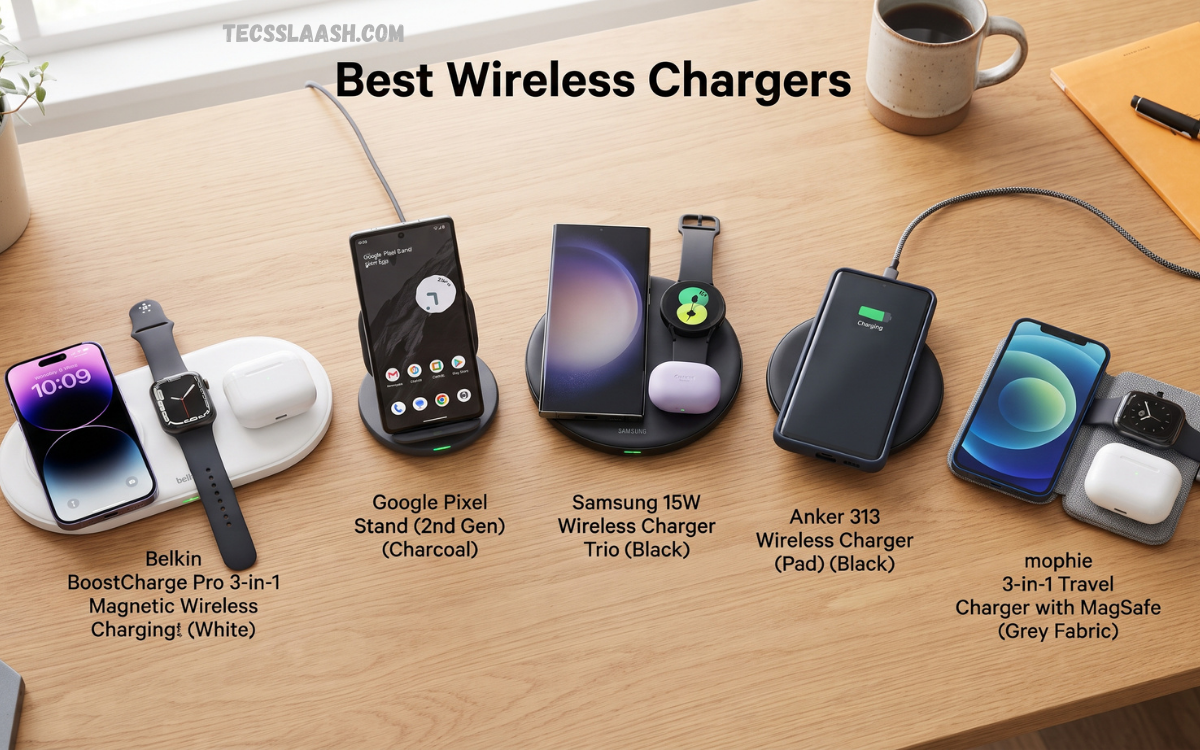
Wireless charging has changed the way people power smartphones, earbuds, smartwatches, and other compatible devices. Instead of searching for a charging cable every time a battery needs power, users can simply place a compatible device on a charging pad or stand.
Choosing among the Best Wireless Chargers can be challenging because wireless chargers differ significantly in charging speed, compatibility, coil placement, power delivery, size, materials, safety features, and price.
What Is a Wireless Charger?
A wireless charger transfers electrical energy to a compatible device through electromagnetic induction. The charger contains one or more coils that create an electromagnetic field when electricity passes through them.
Most modern smartphones that support wireless charging use the Qi standard or a compatible implementation of it. Newer charging technologies can provide improved efficiency, faster charging, and better communication between the charger and the device.
Why Choose the Best Wireless Chargers?
The main advantage of wireless charging is convenience. Users can place a smartphone on a charging surface without repeatedly connecting and disconnecting a cable. This can be particularly useful for people who frequently charge their phones throughout the day. A well-designed charger also makes it easier to maintain a consistent battery level without interrupting normal activities.
The Best Wireless Chargers can also provide a cleaner and more organized charging setup. A single charging station may replace several cables on a bedside table or desk. Some models support multiple devices, allowing users to charge a smartphone, earbuds, and smartwatch from one compact location. The best choice depends on the devices being charged and the user’s preferred charging routine.
Wireless Charging Standards Explained
Qi is one of the most widely recognized wireless charging standards. It provides a common framework that allows compatible devices and chargers to communicate and transfer power safely. Many Android smartphones, iPhones, earbuds, and other accessories support Qi-based wireless charging, although charging speeds and additional features can vary between manufacturers.
Newer generations of wireless charging technology are designed to improve performance and efficiency. Magnetic alignment can help position a device correctly over the charging coil, reducing the likelihood of interrupted charging. Before purchasing a charger, users should check which wireless charging standard and charging protocol their specific device supports.
Charging Speed Matters
Charging speed is one of the most important considerations when comparing wireless chargers. Different chargers can provide different power levels, but the actual charging speed depends on the phone or accessory. A smartphone may support only a certain maximum wireless charging input, meaning a higher-rated charger will not necessarily charge it faster.
For everyday use, a charger with an appropriate power output is usually more important than simply choosing the highest number available. Users should check the manufacturer’s specifications for their smartphone and choose a charger capable of supporting the required charging protocol. A compatible power adapter is also important because the charger cannot deliver its rated performance if the power source is insufficient.
Magnetic Wireless Chargers
Magnetic wireless chargers use magnets to align the charging coil with the receiving coil inside a compatible device. This alignment can improve convenience because the charger can attach to the back of the smartphone rather than requiring the user to position the device manually on a flat pad.
Magnetic charging can be particularly useful for people who use their phones while charging. A magnetic charger may remain attached to the phone while the device is being held or moved. However, users should confirm that their smartphone supports the required magnetic charging system or use an appropriate compatible case.
Wireless Charging Pads
Wireless charging pads are among the simplest charging solutions. They usually have a flat surface where users place their smartphone. Their compact design makes them suitable for desks, bedside tables, kitchen counters, and travel bags.
The primary benefit of a charging pad is simplicity. There are fewer moving parts, and the device can usually be placed on the surface quickly. However, positioning can sometimes be less convenient than a magnetic system because the phone must remain properly aligned with the charging coil.
Wireless Charging Stands
Wireless charging stands hold a smartphone at an elevated angle while charging. This design allows users to view the display while the phone remains on the charger. It can be particularly useful for video calls, notifications, desk work, and watching content.
A charging stand can also provide a more convenient bedside setup. Users can see the time or notifications without lifting the phone. Some stands support both horizontal and vertical positioning, providing additional flexibility for different activities.
Multi-Device Wireless Charging Stations
Multi-device charging stations are designed for users who own several compatible devices. A single station may support a smartphone, smartwatch, earbuds, or another accessory. This approach can significantly reduce cable clutter and provide a dedicated charging area.
When choosing a multi-device charger, compatibility should be checked carefully. Some charging stations are designed for specific device ecosystems and may not support every wireless charging standard. Users should also consider the total power available because multiple devices charging simultaneously may divide the available power.
What Makes the Best Wireless Chargers Safe?
Safety should be a major consideration when selecting a wireless charger. Quality chargers commonly include protections against overheating, overcurrent, overvoltage, short circuits, and excessive temperature. These features help protect both the charger and the connected device during charging.
Heat management is particularly important because wireless charging can generate more heat than some wired charging situations. A charger with appropriate thermal protection can reduce charging power when temperatures become excessive. Users should also avoid covering the charger with thick materials or placing it in an area where heat cannot escape.
Importance of Alignment
Correct alignment between the charging coils affects wireless charging performance. If the device is positioned too far from the charging coil, charging may become slower or stop completely. Poor alignment can also increase energy loss and heat generation.
Magnetic charging systems can simplify alignment by guiding the device into the correct position. Traditional charging pads require more attention, especially when the charging area is relatively small. A larger charging surface can provide greater flexibility for positioning a phone.
Choosing a Wireless Charger for Smartphones
The first step in selecting a smartphone wireless charger is confirming whether the phone supports wireless charging. Not every smartphone includes this feature, and compatibility varies between models. After confirming compatibility, users should check the maximum wireless charging speed supported by the device.
The next consideration is the preferred form factor. A flat pad may be ideal for simple charging, while a stand may be better for desk use. A magnetic charger may be preferable for users who want secure alignment. The ideal option depends on how and where the smartphone is normally charged.
Choosing a Wireless Charger for iPhone Users
iPhone users should pay close attention to compatibility with Apple’s wireless charging and magnetic charging technologies. A compatible magnetic charger can provide convenient alignment and may work effectively with compatible cases and accessories.
Users should also consider the charging adapter and cable supplied with the charger. The charging puck or stand alone does not determine the complete charging experience. The power adapter, cable quality, phone model, and charging protocol can all influence performance.
Choosing a Wireless Charger for Android Phones
Android users have a wide range of wireless charging options because many manufacturers support Qi-based charging. However, maximum charging speeds can differ substantially between smartphone brands and models.
Before purchasing, check the phone’s official specifications for supported wireless charging power and standards. A charger that supports the phone’s maximum capability can provide a better experience, while an incompatible proprietary charging system may limit performance.
Wireless Chargers for Earbuds
Wireless charging is not limited to smartphones. Many modern wireless earbuds use charging cases that support wireless charging. This makes it possible to place the case on a compatible charging pad whenever the battery needs power.
For earbuds, charging speed is usually less important than convenience and compatibility. Because earbud cases have relatively small batteries, a standard wireless charger can often provide practical charging without requiring a high-power charging system.
Wireless Chargers for Smartwatches
Smartwatches often require specialized charging systems. Although some charging accessories may appear similar to standard wireless charging pads, a smartwatch may need a proprietary charger or specific magnetic charging mechanism.
Users should therefore verify smartwatch compatibility before purchasing a multi-device wireless charging station. A station that supports a smartphone and earbuds may not necessarily support every smartwatch model.
Read Also: Best AI Photo Editing Apps for Stunning Results
Wireless Charging and Phone Cases
Phone cases can affect wireless charging performance, particularly when they are thick or contain metal components. A compatible case designed for wireless charging generally provides better results than a heavy case that interferes with electromagnetic transmission.
Magnetic charging systems may require a compatible magnetic case or built-in magnetic ring. Users who frequently charge their phone wirelessly should consider case compatibility when selecting both the charger and protective case.
Does Wireless Charging Damage Battery Health?
Wireless charging itself does not automatically damage a smartphone battery. Battery longevity is influenced by factors such as temperature, charging cycles, battery chemistry, charging behavior, and the device’s battery-management system.
Heat is an important factor. Excessive temperature can accelerate battery degradation over time. Using a reputable charger with appropriate thermal management and keeping the phone in a well-ventilated area can help maintain a healthier charging environment.
Wireless Charging Efficiency
Wireless charging is generally less energy-efficient than direct wired charging because energy must transfer through electromagnetic fields rather than directly through a physical electrical connection. Some energy can be lost during transmission and converted into heat.
Modern wireless charging systems have improved considerably, but users who prioritize maximum efficiency and fastest possible charging may still prefer wired charging in certain situations. Wireless charging is primarily attractive because of convenience and ease of use.
Best Wireless Chargers for Travel
Travel chargers should be compact, lightweight, and easy to pack. A small charging pad can take up very little space and may be ideal for users who need a simple solution while traveling. Foldable charging stands can provide additional flexibility without adding much bulk.
Multi-device travel chargers can be useful for people carrying several devices. Instead of packing multiple charging accessories, a single station may handle a smartphone, earbuds, and smartwatch. However, travelers should confirm compatibility before relying on one charger for an entire device setup.
Best Wireless Chargers for Office Desks
A wireless charging stand can be particularly effective in an office environment. It keeps the phone visible while providing continuous charging. This allows users to monitor notifications, check calendars, or participate in video calls without constantly handling the phone.
A charging pad is another practical choice for an office desk, especially when the phone does not need to remain visible. Cable management is also important. A well-organized charging setup can make the workspace cleaner and reduce the number of cables competing for desk space.
Best Wireless Chargers for Bedside Tables
For bedside use, convenience and reliability are often more important than extreme charging speed. A charging stand can keep the smartphone positioned where the screen is easy to see. Some users may prefer a flat pad because it allows the phone to remain unobtrusive during sleep.
Heat management is especially important overnight. Users should place the charger on a hard, ventilated surface and avoid covering the phone or charger with blankets. A reliable charger can provide a safer and more consistent overnight charging experience.
Features to Look for in the Best Wireless Chargers
When comparing the Best Wireless Chargers, look for features that match your actual needs rather than selecting a charger based only on its advertised power rating. Important factors include wireless charging compatibility, maximum supported power, alignment, temperature control, build quality, cable quality, and power adapter compatibility.
Other useful features include LED indicators, foldable designs, adjustable viewing angles, magnetic alignment, multi-device charging, and compact construction. A premium feature is valuable only when it solves a real problem in your daily charging routine.
Build Quality and Design
Build quality affects durability and everyday usability. A good wireless charger should remain stable on a desk and provide a reliable charging surface. Non-slip materials can help prevent the phone from sliding away from the charging coil.
Design also matters because wireless chargers are often left in visible locations. A compact, minimalist charger may fit better into a modern workspace, while a larger charging station may be preferable for households with several devices. The best design is ultimately the one that fits naturally into the user’s environment.
Power Adapter Compatibility
One frequently overlooked factor is the power adapter. A wireless charger may be capable of high-speed charging, but the supplied or selected adapter must provide sufficient power. Using an underpowered adapter can reduce charging performance.
Users should check the charger’s recommended input requirements and use a reliable power adapter that meets those specifications. A high-quality cable is also important because poor-quality cables can limit power delivery or create reliability issues.
Wireless Charging vs Wired Charging
Wireless charging offers superior convenience because users can charge a compatible device simply by placing it on a charging surface. It also reduces the repeated wear associated with connecting and disconnecting a charging cable.
Wired charging generally remains advantageous when maximum speed, energy efficiency, or uninterrupted device use is the priority. Wireless charging is better suited to convenient top-ups and dedicated charging locations. Many users benefit from keeping both options available.
Common Wireless Charging Mistakes
One common mistake is purchasing a charger without checking device compatibility. Another is assuming that the charger’s maximum advertised power will automatically be delivered to the smartphone. Actual charging speed depends on the device, protocol, adapter, cable, and charging conditions.
Poor positioning is another frequent issue. If the smartphone is not correctly aligned with the charging coil, charging may become intermittent or slower. Thick cases, metal accessories, and excessive heat can also affect performance.
How to Maintain a Wireless Charger
Keeping a wireless charger clean can help maintain reliable contact and positioning. Dust, dirt, and debris should be removed carefully from the charging surface. Users should also inspect the cable and power adapter periodically for signs of damage.
Avoid placing heavy objects on the charger or exposing it to unnecessary moisture. If a charger becomes unusually hot, produces an unusual smell, or behaves inconsistently, discontinue use and investigate the issue rather than continuing to operate it.
Are Expensive Wireless Chargers Worth It?
Price does not always determine charging performance. Some affordable chargers can provide excellent everyday performance when paired with compatible devices. However, premium chargers may offer better materials, stronger magnetic alignment, improved thermal management, multi-device functionality, and more refined designs.
The best approach is to compare specifications and features instead of purchasing based solely on brand reputation or price. A simple user may need only a reliable charging pad, while someone with multiple devices may benefit from investing in a premium charging station.
How to Select the Best Wireless Charger
Start by identifying the devices that need charging. If you only charge one smartphone, a simple pad or stand may be sufficient. If you regularly charge several devices, a multi-device station can reduce clutter and simplify your routine.
Next, check wireless charging compatibility, supported power levels, charging protocols, physical design, and safety features. Consider where the charger will be used most frequently. A travel charger should prioritize portability, while a bedside charger should prioritize stability and convenient positioning.
Frequently Asked Questions
What are the Best Wireless Chargers?
The Best Wireless Chargers are models that combine reliable compatibility, appropriate charging speed, safe thermal management, strong build quality, and convenient design. The ideal charger depends on the smartphone and accessories being used.
Are wireless chargers safe?
Quality wireless chargers are designed with protection systems that help manage temperature, current, voltage, and charging conditions. Users should choose reputable products and follow manufacturer recommendations.
Can wireless chargers charge through phone cases?
Many wireless chargers can charge through compatible thin cases. Thick cases, metal components, or magnetic accessories that are not designed for wireless charging can interfere with performance.
Is wireless charging slower than wired charging?
Wireless charging can be slower than wired charging, depending on the device and charger. Modern wireless systems can provide relatively fast charging, but wired charging may still offer higher maximum speeds.
Can I use a wireless charger overnight?
Many users charge their smartphones overnight using wireless chargers. A quality charger with appropriate thermal protection is preferable, and the device should be placed on a hard, ventilated surface.
Do wireless chargers work with Android phones?
Many Android smartphones support Qi wireless charging. However, compatibility and maximum charging speeds vary by model, so users should check their phone’s specifications before purchasing.
Do wireless chargers work with iPhones?
Compatible iPhones support wireless charging, while some models also support magnetic charging systems. Users should select a charger designed for their specific iPhone model and desired charging method.
Can wireless chargers charge earbuds?
Many wireless earbud cases support wireless charging. Compatibility should be confirmed because not every earbud case supports wireless charging.
Does a wireless charger use electricity when no phone is connected?
A wireless charger may consume a small amount of standby power when connected to an electrical outlet without a device charging. The amount varies by charger design and efficiency.
How can I improve wireless charging speed?
Use a compatible charger, appropriate power adapter, and suitable cable. Keep the device correctly aligned with the charging coil and avoid excessive heat. Removing an unusually thick case may also improve charging performance.
Conclusion
The Best Wireless Chargers combine convenience, compatibility, reliable performance, and appropriate safety features. The right model is not necessarily the charger with the highest advertised power. Instead, it should match the wireless charging capabilities of your smartphone and other devices while fitting naturally into your daily routine.
For a simple setup, a compact charging pad can provide an effective solution. A charging stand may be better for office or bedside use, while a magnetic charger can provide secure alignment and easier handling. Users with several compatible devices may benefit most from a multi-device charging station.

