


Professional content creation requires more than simply putting words on a page. Writers, marketers, bloggers, businesses, and publishers need strong ideas, clear structure, consistent tone, accurate information, and content that connects with a specific audience.
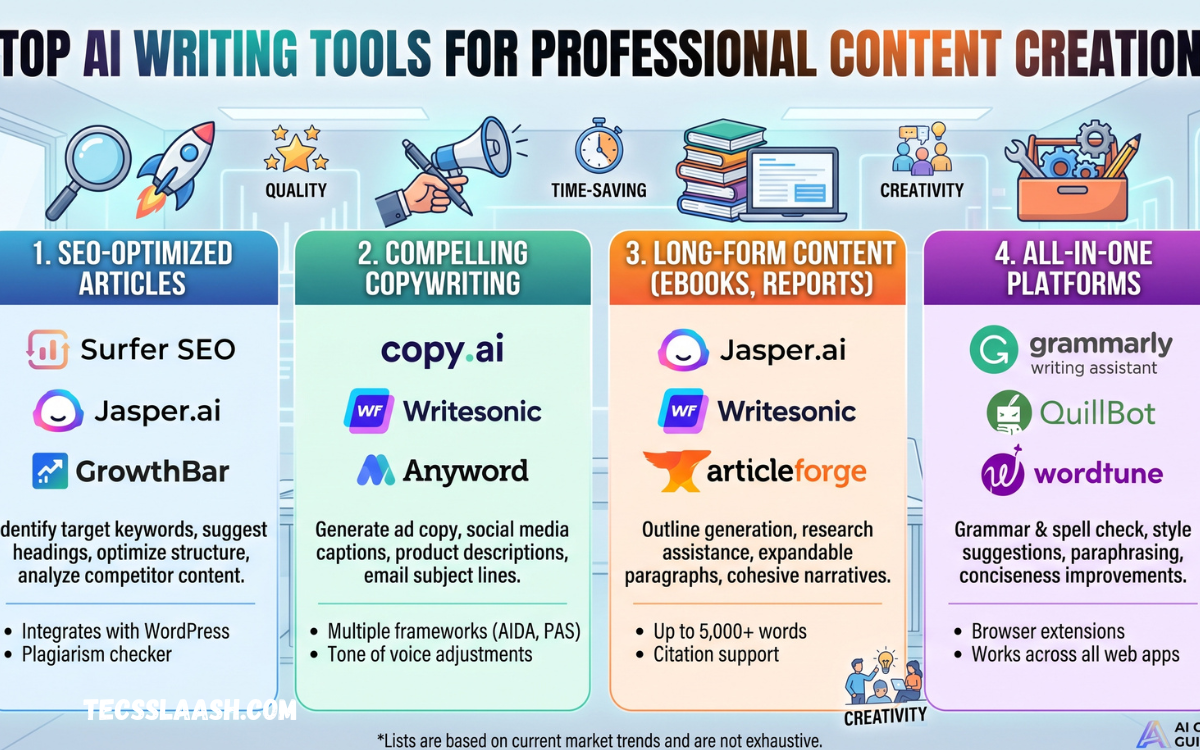
The Top AI Writing Tools for Professional Content Creation can support these tasks by helping with brainstorming, outlining, drafting, rewriting, editing, and content planning. In 2026, AI writing platforms range from general-purpose assistants to specialized marketing, SEO, research, and editing solutions.
Why AI Writing Tools Matter for Professional Content?
Professional writers often spend significant time researching topics, developing outlines, improving sentences, and adapting the same information for different platforms. A capable writing assistant can reduce repetitive work and help writers move more efficiently from an initial idea to a polished draft.
The greatest value comes when AI is treated as a productivity assistant rather than a replacement for professional judgment. Human writers still provide originality, experience, brand knowledge, personal perspective, and final editorial decisions that determine whether content is genuinely useful.
ChatGPT for Versatile Content Creation
ChatGPT is one of the most flexible choices for professional content creation because it can assist with brainstorming, outlines, articles, emails, social media content, summaries, rewriting, and many other writing tasks. Its broad capabilities make it useful when one tool needs to support several different content workflows.
For professional writers, the quality of the result depends heavily on the instructions and information provided. Giving the tool a clear audience, purpose, tone, structure, keywords, and factual background can produce a much more useful starting draft than using a short generic prompt.
Claude for Long-Form Professional Writing
Claude is particularly useful for writers working with longer documents and detailed instructions. Current comparisons frequently highlight its long-form writing quality and ability to maintain context across substantial documents, making it a strong option for articles, reports, explanations, and other extended content.
Its biggest advantage for professional writers is the ability to work with nuanced instructions and preserve a consistent writing direction. However, every generated draft should still be reviewed for accuracy, originality, tone, and unnecessary repetition before publication.
Grammarly for Editing and Refinement
Grammarly is best understood as an editing companion rather than simply a content generator. It can help writers identify grammar problems, improve clarity, adjust tone, and make professional writing easier to read.
For businesses and professional publishers, editing is just as important as drafting. Even a well-researched article can lose credibility because of awkward wording, grammatical mistakes, excessive repetition, or unclear sentences, so an effective editing stage can significantly improve the final result.
Jasper for Marketing Content
Jasper is designed with marketing teams and brand-focused content creation in mind. Its strength is helping organizations produce marketing materials while maintaining a consistent brand voice across different campaigns and content formats. Current 2026 comparisons continue to position Jasper as a specialized option for marketing teams.
This makes it useful for businesses that create landing-page copy, advertising content, promotional messaging, campaign materials, and other marketing assets. The main benefit is not simply generating more words but creating repeatable workflows that help teams maintain consistency.
Copy.ai for Business Content
Copy.ai has developed beyond simple copy generation and is increasingly positioned around business and go-to-market workflows. It can be useful for teams that need structured marketing content, sales messaging, campaign ideas, and other business-focused material.
For professional users, specialized workflows can save time because writers do not always have to begin from a blank page. Nevertheless, generated business content should be reviewed carefully so that claims, product information, terminology, and messaging accurately represent the organization.
Writesonic for SEO Content
Writesonic is a useful option for content creators who combine writing with search-focused content workflows. Current comparisons describe it as increasingly focused on SEO and AI-search visibility rather than functioning solely as a basic article generator.
For bloggers and website owners, this can make the content process more organized. A strong workflow can begin with search intent and topic research, continue through an outline and draft, and finish with human editing that improves usefulness rather than simply adding keywords.
Rytr for Fast Everyday Writing
Rytr is aimed at users who need quick assistance with everyday writing tasks. It can be useful for short-form copy, product descriptions, social media ideas, emails, and other routine content where speed and simplicity are important.
Its value is especially noticeable for freelancers and small businesses that do not need a complicated enterprise workflow. Instead of replacing the writer, it can provide starting points that are then rewritten and personalized to match the intended audience and brand voice.
Read Also: Best Phone Cases for Protection, Style, and Everyday Use
Perplexity for Research-Based Content
Research is an essential part of professional writing, especially when an article depends on current information, competing viewpoints, statistics, or supporting evidence. Perplexity is frequently positioned as a research-oriented AI tool because it emphasizes source-grounded answers rather than functioning only as a conventional writing assistant.
A professional workflow can use research assistance before drafting begins. Writers should still open and evaluate important sources themselves, verify significant claims, and avoid publishing information simply because an AI system presents it confidently.
How to Choose the Right AI Writing Tool
The best tool depends on the type of content being produced. A general writer may prefer a flexible assistant, a marketing department may need brand controls, an SEO publisher may want search-focused features, and an editor may prioritize grammar and readability.
Budget, workflow, content volume, integrations, ease of use, and editing capabilities should also influence the decision. Instead of choosing the tool with the largest feature list, professionals should select the platform that solves their most frequent writing problem efficiently.
Build a Professional AI Writing Workflow
A strong workflow usually starts with human planning. Define the purpose, audience, topic, search intent, key points, tone, and desired outcome before asking an AI tool to produce a draft.
The next stage should involve drafting, fact-checking, restructuring, editing, and personalization. This approach allows AI to handle repetitive portions of the process while the writer remains responsible for the quality and originality of the final publication.
AI Writing Tools Should Not Replace Human Expertise
AI can generate fluent sentences, but fluent writing does not automatically mean accurate or valuable writing. Professional content requires judgment about context, credibility, audience expectations, originality, and the practical usefulness of information.
Human expertise is particularly important for technical, financial, legal, medical, and business content. Writers should verify important claims and add genuine insights rather than publishing an unedited AI-generated draft.
Benefits of Using AI Writing Tools
One major benefit is productivity. Writers can use AI assistance to brainstorm several approaches, develop an outline, create alternative headlines, simplify complicated passages, or transform existing material into a different format.
Another benefit is consistency. A well-designed workflow can help a content team maintain a recognizable structure and tone across multiple pieces. This is especially useful for organizations publishing frequently across blogs, websites, newsletters, social platforms, and marketing campaigns.
Common Mistakes to Avoid
One of the biggest mistakes is publishing AI-generated content without meaningful human review. Even when a draft sounds professional, it can contain inaccurate statements, repetitive ideas, weak examples, or generic language that does not provide readers with anything distinctive.
Another mistake is focusing exclusively on keyword placement. Professional SEO content should satisfy the reader first. Keywords should naturally support the topic while the article provides clear answers, useful information, strong organization, and genuine value.
Future of Professional AI Content Creation
AI writing technology is moving toward more specialized and integrated workflows rather than simple text generation. Modern platforms increasingly combine writing, editing, research, planning, brand control, and content optimization in broader systems.
This evolution means professional writers will increasingly benefit from knowing how to direct, evaluate, and edit AI-assisted work. The strongest content strategy will combine technology with human creativity, experience, editorial judgment, and a clear understanding of the audience.
Frequently Asked Questions
What are the Top AI Writing Tools for Professional Content Creation?
Popular choices include ChatGPT, Claude, Grammarly, Jasper, Copy.ai, Writesonic, Rytr, and Perplexity. Each has different strengths, so the right option depends on whether the primary requirement is drafting, editing, marketing, SEO, research, or general productivity.
Which AI writing tool is best for long-form articles?
Claude and ChatGPT are strong general-purpose choices for long-form articles. Both can help with outlining, drafting, restructuring, and refinement when given detailed instructions and sufficient context.
Which AI writing tool is best for marketing content?
Jasper and Copy.ai are strong options for marketing-focused workflows. They are designed around business and marketing use cases and can help teams create campaign-related content more efficiently.
Are AI writing tools useful for SEO content?
Yes, AI writing tools can assist with SEO research, outlines, content organization, keyword integration, rewriting, and optimization. Specialized platforms can also provide additional search-focused workflows.
Can AI writing tools create professional content automatically?
AI tools can create drafts quickly, but automatic generation does not guarantee professional-quality publishing. Strong professional content requires research, editing, fact-checking, audience understanding, and original perspective.
Are AI writing tools suitable for freelancers?
Yes, freelancers can use AI writing tools to speed up brainstorming, outlining, editing, rewriting, and content planning. They can be particularly helpful when a freelancer manages multiple clients and content formats.
Can AI writing tools improve grammar and readability?
Yes, dedicated editing tools can identify grammatical problems, unclear wording, excessive complexity, and tone issues. This makes them useful during the final editing stage.
Should businesses use AI-generated content without editing?
Businesses should avoid publishing important content without human review. AI-generated drafts can contain incorrect information, generic language, or statements that do not accurately represent a company’s products or policies.
How can writers make AI-assisted content more original?
Writers can improve originality by providing their own ideas, experiences, examples, research, opinions, and industry knowledge. Instead of asking AI to produce a complete article immediately, they can use it for brainstorming and structural assistance.
Are AI writing tools replacing professional writers?
AI tools are changing the writing process, but professional writers remain important for strategy, creativity, research, storytelling, editing, and judgment. Current writing-tool comparisons increasingly emphasize AI as an assistant within broader workflows rather than a complete replacement for skilled writers.
Conclusion
The Top AI Writing Tools for Professional Content Creation offer powerful ways to improve productivity, organization, research, drafting, editing, and content planning. Tools such as ChatGPT, Claude, Grammarly, Jasper, Copy.ai, Writesonic, Rytr, and Perplexity serve different professional needs and should be selected according to the user’s workflow.
The most effective strategy is not to let AI write everything without supervision. Instead, use AI for repetitive and time-consuming tasks while keeping humans responsible for research, creativity, accuracy, originality, editing, and final approval.

