


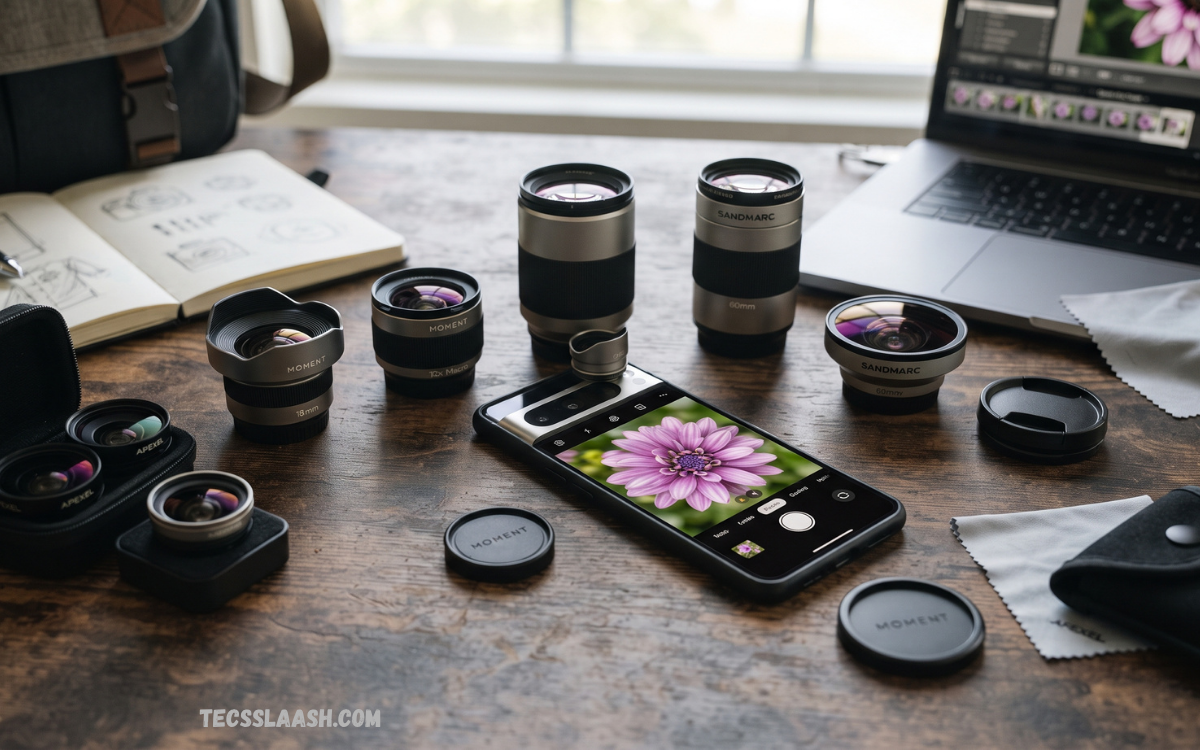
Smartphone photography has evolved into a powerful creative field, allowing users to capture detailed portraits, landscapes, travel scenes, products, food, wildlife, and everyday moments without carrying heavy camera equipment. Modern phones already include advanced sensors, computational photography, image stabilization, multiple cameras, and intelligent software.
The best phone camera lenses help mobile photographers capture wider scenes, closer subjects, stronger optical reach, and more dramatic visual effects. A quality lens attachment can transform an ordinary smartphone camera into a more flexible photography tool.
Why Phone Camera Lenses Matter for Mobile Photography?
Built-in smartphone cameras offer great convenience, yet physical limitations persist. A phone camera lens attachment changes the optical field of view before light reaches the smartphone sensor. Unlike simple digital cropping or software zoom, a quality optical accessory can provide a genuinely different perspective and preserve more useful image information.
The best phone camera lenses also allow photographers to experiment with specialized styles of photography. A macro lens reveals fine textures, a telephoto lens captures distant subjects, while a wide-angle lens fits more scenery into one frame.
Wide-Angle Lenses for Larger Scenes
A wide-angle lens increases the visible area inside the frame. This makes it useful for landscapes, architecture, travel photography, real estate content, group photos, and indoor scenes where stepping backward is impossible. Wide-angle photography creates a stronger sense of space and allows photographers to capture more environmental detail.
The best phone camera lenses in the wide-angle category should maintain good sharpness across most of the frame and control excessive distortion. Some wide lenses stretch objects near the edges, particularly when subjects stand close to the camera. Premium optical designs reduce these problems and create cleaner, more natural-looking images.
Telephoto Lenses for Distant Subjects
A telephoto lens provides optical magnification for subjects located farther from the camera. This lens type works well for portraits, wildlife, sports, travel details, architecture, and events. It allows photographers to frame a distant subject more tightly without moving physically closer.
A strong telephoto attachment can provide a useful alternative when a phone’s built-in zoom camera lacks enough optical reach. However, stability becomes increasingly important at longer focal lengths. Even small hand movements can affect sharpness, making a tripod, stabilizer, or careful shooting technique valuable for consistent results.
Macro Lenses for Extreme Close-Up Photography
Macro photography focuses on small subjects and tiny details. A dedicated macro lens can reveal textures and patterns that remain almost invisible during normal viewing. Flowers, insects, jewelry, fabrics, coins, electronics, food details, and product surfaces become interesting photographic subjects with macro optics.
The best phone camera lenses for macro photography should provide strong center sharpness and allow accurate focus at close distances. Lighting also becomes extremely important because the lens sits near the subject and may block available light. Natural side lighting, small LED lights, or controlled studio lighting can improve macro image quality significantly.
Fisheye Lenses for Creative Photography
A fisheye lens creates an ultra-wide view with strong barrel distortion. Straight lines curve outward, producing a rounded and dramatic visual style. This effect can make ordinary scenes look energetic, playful, unusual, or cinematic when used with careful composition.
Fisheye lenses are popular for action photography, skateboarding, architecture experiments, creative travel images, and social media content. They are not designed for every situation, but photographers seeking a distinctive perspective may find them valuable. Strong optical quality remains important because low-quality fisheye accessories often produce excessive softness around image edges.
Portrait Lenses for Better Subject Separation
Portrait photography focuses attention on a person or primary subject. A longer focal length can create more flattering proportions by avoiding the exaggerated perspective sometimes produced by very wide smartphone cameras. Telephoto-style attachments can therefore help photographers create stronger portrait compositions.
The best phone camera lenses for portraits should preserve facial detail while supporting comfortable shooting distance. Background separation may also improve depending on focal length, subject distance, sensor size, and phone software. A good portrait combines lens choice with lighting, composition, background selection, and accurate focus.
Anamorphic Lenses for Cinematic Mobile Video
Anamorphic lenses are designed primarily for video creators seeking a wider cinematic appearance. They squeeze a broad image onto the smartphone sensor, allowing compatible software to process or desqueeze the footage into a wider final frame. Some designs can also create horizontal flare characteristics associated with cinematic filmmaking.
Mobile filmmakers use anamorphic lenses for short films, music videos, travel videos, commercials, and creative social media productions. Lens alignment is essential because incorrect mounting can distort the final image. A reliable mounting system and compatible camera application can make the shooting process easier and more consistent.
Lens Quality and Optical Glass
Not every phone camera lens delivers the same image quality. Optical glass generally provides better clarity and durability than extremely cheap plastic optics. Premium lenses may use multi-element designs and specialized coatings to reduce reflections, ghosting, chromatic aberration, and contrast loss.
When comparing the best phone camera lenses, photographers should examine sample images rather than relying only on marketing descriptions. Sharpness near the center and corners, color accuracy, distortion control, flare resistance, and edge performance all matter. A well-designed lens should improve creative capability without creating major optical problems.
Compatibility with Your Smartphone
Compatibility is one of the most important factors before purchasing a phone camera lens. Smartphones have different camera positions, camera sizes, protective glass layouts, and protruding camera modules. A lens that works well on one device may not align correctly with another model.
Dedicated mounting systems often provide more accurate alignment than basic universal clips. Before buying, check whether the lens system supports your specific phone and whether it works with the primary, ultra-wide, or telephoto camera. Proper alignment helps prevent dark corners, reduced sharpness, and unwanted vignetting.
Clip-On Phone Camera Lenses
Clip-on lenses offer a simple and affordable way to experiment with mobile photography. They usually attach over the smartphone camera through a spring-loaded clip. Many beginner kits include multiple lens types, such as wide-angle, macro, and fisheye options.
The main advantage of clip-on lenses is convenience. However, alignment can be inconsistent, particularly on phones with large camera modules. Users should carefully position the lens over the correct camera and test the preview before shooting. Better-quality clips with stable mounts usually provide more reliable results.
Dedicated Case Mount Systems
Dedicated case systems are designed for specific smartphone models and position the lens accurately over the camera. The user attaches the lens through a threaded or bayonet-style mount. This design generally provides stronger stability and faster lens changes during photography sessions.
Photographers who regularly use external optics may prefer dedicated systems because accurate alignment reduces common problems. These systems can cost more than universal clip-on accessories, yet the improved stability and consistency may justify the investment for serious creators and mobile photography professionals.
Magnetic Phone Camera Lens Systems
Magnetic lens mounts offer quick attachment and removal. A properly designed magnetic system can help users switch between wide-angle, macro, telephoto, and other lenses without repeatedly adjusting a spring clip. This can improve workflow during travel, events, and fast-moving content production.
Magnetic systems still require strong alignment and secure attachment. Buyers should confirm that the mounting ring or compatible case fits their smartphone correctly. A secure mount is especially important when using larger telephoto or anamorphic lenses because additional weight can affect balance and handling.
Best Phone Camera Lenses for Travel Photography
Travel photography requires versatility because photographers may capture landscapes, buildings, food, portraits, streets, and distant landmarks during the same trip. A wide-angle lens can capture large environments, while a telephoto lens helps isolate architectural details or distant scenes.
A compact lens kit provides greater flexibility without adding the weight of a full camera system. The best phone camera lenses for travel should also include protective caps, a small carrying case, and reliable mounting equipment. Lightweight accessories make travel photography easier and reduce the risk of carrying unnecessary equipment.
Best Phone Camera Lenses for Content Creators
Content creators need tools that support consistent visual quality across photographs and videos. Product photography, tutorials, travel reels, food videos, interviews, and lifestyle content can all benefit from specialized smartphone lenses. The ideal choice depends on the creator’s primary content format.
Wide-angle and macro lenses provide strong versatility for many creators, while telephoto and anamorphic lenses serve more specialized needs. Video creators should also consider stabilization, microphone placement, lighting accessories, and tripod compatibility because lens performance represents only one part of a complete mobile production setup.
Best Phone Camera Lenses for Product Photography
Small businesses and online sellers often need detailed product images for websites, catalogs, marketplaces, and social media. A macro lens can capture close textures and small features, while a standard or telephoto perspective can create cleaner product proportions without excessive wide-angle distortion.
Lighting remains critical for product photography. Even the best phone camera lenses cannot compensate fully for poor lighting. Soft, even illumination helps reveal accurate colors and textures, while a stable phone mount supports consistent framing. Combining a quality lens with controlled lighting can produce more professional results.
Best Phone Camera Lenses for Landscape Photography
Landscape photography benefits from a broad field of view, foreground detail, and strong composition. A wide-angle attachment can capture mountains, coastlines, city skylines, forests, and large natural environments. Including foreground objects can add depth and guide viewers through the scene.
Photographers should avoid relying only on the widest possible view. Extreme wide-angle perspectives can make distant subjects appear very small. Effective landscape photography combines lens selection with composition, weather, lighting direction, and careful exposure to create a balanced and visually engaging image.
Best Phone Camera Lenses for Food Photography
Food photography requires attention to texture, color, shape, and presentation. A macro lens can reveal small details, while a standard perspective may better represent an entire plate. Wide lenses can sometimes distort food positioned near the frame edges, making lens choice important.
Natural window light often produces attractive results for food photography. Photographers can position the subject near soft side light and use simple reflectors to reduce harsh shadows. The best phone camera lenses support detail and creative perspective, but thoughtful styling remains essential.
Best Phone Camera Lenses for Social Media Photography
Social media photography benefits from visual variety. Different lenses allow creators to produce wider environments, dramatic close-ups, compressed backgrounds, and unusual perspectives. This variety can help maintain a distinctive visual identity across posts and content campaigns.
However, creative effects should support the subject rather than overwhelm it. A fisheye image may attract attention, but it may not suit every brand or photograph. Consistent lighting, editing, composition, and storytelling remain more important than using unusual effects in every image.
Image Sharpness and Focus Performance
Sharpness is a major consideration when selecting external smartphone lenses. A lens may appear sharp in the center but become soft toward the edges. This issue can become noticeable in landscapes, architecture, and other scenes containing detail across the entire frame.
Focus performance also depends on the smartphone camera and camera application. Some phones may switch automatically between different built-in cameras, creating compatibility problems with an attached lens. Users should test camera settings and ensure the intended sensor remains active during shooting.
Distortion and Vignetting
Optical distortion changes the appearance of shapes and straight lines. Wide-angle and fisheye lenses naturally produce more visible distortion, although high-quality optical designs can control it effectively. Some distortion may also be corrected through editing applications after shooting.
Vignetting appears as darkening around image edges and may occur when a lens is poorly aligned or does not fully cover the smartphone camera’s field of view. Checking the live preview before taking important photographs can prevent many problems caused by incorrect mounting.
Chromatic Aberration and Color Fringing
Chromatic aberration occurs when different colors do not focus at exactly the same point. It can create colored edges around high-contrast subjects, especially near the outer parts of an image. This problem may become visible around branches, buildings, metal edges, and bright subjects against dark backgrounds.
Premium lenses use better optical designs to reduce color fringing. Some photo editing applications can also correct chromatic aberration after capture. For photographers seeking professional results, examining edge quality and high-contrast test images provides useful information before choosing a lens.
Lens Coatings and Flare Control
Lens coatings improve light transmission and reduce unwanted reflections. Shooting toward bright sunlight or strong artificial lighting can create flare, ghosting, and reduced contrast. While some cinematic creators intentionally use flare for creative style, uncontrolled reflections can reduce image quality.
The best phone camera lenses often use coatings to maintain contrast under challenging lighting conditions. Photographers can also improve results by changing camera angle, blocking stray light, cleaning the lens surface, and avoiding fingerprints on both the smartphone camera and external lens.
Read Also: Best Laptop Cooling Pad: Top Choices for Maximum Cooling and Performance
Build Quality and Durability
A phone camera lens should withstand regular handling, travel, and repeated attachment. Metal housings and durable mounting systems generally provide better long-term reliability than fragile accessories. Protective caps are also useful because dust and scratches can affect optical quality.
Lens weight should match the intended use. Extremely heavy attachments may make a smartphone uncomfortable to hold and difficult to stabilize. A compact, well-built lens with reliable optics often provides greater practical value than a large accessory used only occasionally.
How to Clean Phone Camera Lenses
Dust, fingerprints, and oil can reduce sharpness and contrast. Before shooting, inspect both the smartphone camera glass and the external lens. A clean microfiber cloth is usually suitable for removing fingerprints and light surface contamination.
Avoid rough materials that may scratch lens coatings. Store lenses with protective caps when not in use, particularly during travel. Regular cleaning helps maintain image quality and prevents small marks from becoming visible when photographing bright scenes or using strong lighting.
Using a Tripod with Phone Camera Lenses
A tripod improves stability and can produce sharper photographs, particularly with telephoto, macro, low-light, and long-exposure shooting. External lenses may change the smartphone’s weight distribution, making stable support even more useful.
For video, a tripod or stabilizing rig can improve framing consistency. Telephoto lenses especially benefit from additional stability because magnification makes small hand movements more visible. A secure phone mount should hold the device firmly without blocking the lens attachment.
Lighting and the Best Phone Camera Lenses
Lighting has a direct effect on image quality. A premium lens cannot fully compensate for dark, uneven, or poorly controlled illumination. Good lighting improves detail, color, contrast, and the overall appearance of smartphone photographs.
Natural daylight works well for many scenes, while LED lights provide more control for indoor photography and video. Macro photography often requires additional lighting because the camera moves very close to the subject. Understanding light direction can improve results more than purchasing multiple unnecessary accessories.
Choosing Between Optical Zoom and Digital Zoom
Optical zoom uses physical lens optics to change the perspective and magnification of a scene. Digital zoom generally enlarges or crops the image through software processing. Smartphone computational photography can make digital zoom impressive, but optical reach still provides advantages in many situations.
A telephoto attachment can help photographers capture distant subjects with a different optical perspective. Results depend heavily on lens quality and mounting accuracy. Buyers should compare real image samples because a poorly designed external lens may not outperform the smartphone’s built-in camera system.
How to Choose the Best Phone Camera Lenses
Start by identifying your primary photography goals. A traveler may prioritize wide-angle and telephoto options, while a product photographer may benefit more from macro capabilities. Video creators may consider anamorphic optics, and casual users may prefer a simple multi-lens kit.
Next, check smartphone compatibility and mounting design. Then compare optical quality, distortion, edge sharpness, lens coatings, build materials, and portability. Buying one high-quality lens designed for a specific purpose can often provide better results than purchasing a large collection of cheap accessories.
Budget Phone Camera Lenses
Budget lenses provide an accessible entry point into mobile photography. They allow beginners to experiment with different focal perspectives and understand how external optics affect composition. A basic kit can be useful for learning wide-angle, macro, and fisheye techniques.
Buyers should manage expectations because very low-cost lenses may produce soft images, alignment problems, reflections, or strong distortion. Testing the lens under different lighting conditions helps determine its limitations. For occasional creative photography, an affordable lens can still provide useful value.
Premium Phone Camera Lenses
Premium options generally focus on stronger optical performance, durable construction, accurate mounting, and better compatibility. These lenses are often designed for serious photographers and creators who want more predictable results during regular use.
The higher cost can make sense when external lenses become part of a regular photography workflow. Better glass, coatings, mechanical design, and mounting systems may improve image consistency. Before investing, photographers should ensure that the system supports their current smartphone and likely future device upgrades.
Common Mistakes When Using Phone Camera Lenses
One common mistake involves mounting the lens over the wrong built-in camera. Modern smartphones contain multiple sensors, and an external attachment must align correctly with the intended camera. Incorrect alignment can create dark corners, softness, or unexpected image problems.
Another mistake involves ignoring lighting and stability. A new lens may change perspective, but it does not automatically create professional photography. Clean optics, accurate focus, stable support, good lighting, and strong composition remain necessary for excellent results.
Editing Photos Taken with External Lenses
Editing can refine images captured with smartphone lens attachments. Basic adjustments may include exposure, highlights, shadows, contrast, white balance, and detail. Wide-angle images may benefit from distortion correction, while some telephoto or macro photographs may need careful sharpening.
Editing should enhance the original image rather than hide major technical problems. Excessive sharpening can create unnatural textures, while strong color adjustments may reduce realism. Starting with a well-exposed, sharp photograph provides more flexibility during post-production.
Phone Camera Lenses for Beginners
Beginners should avoid buying too many specialized accessories immediately. A quality wide-angle or macro lens can teach important lessons about perspective and composition. After gaining experience, photographers can identify which additional focal options match their shooting style.
Learning how each lens changes the relationship between foreground and background is especially valuable. The best phone camera lenses are tools, not automatic solutions. Regular practice helps photographers understand when a particular perspective strengthens an image.
Phone Camera Lenses for Professional Creators
Professional creators require consistent performance and dependable workflow. They may need accurate mounting, repeatable image quality, durable construction, and compatibility with stabilizers, cages, filters, microphones, and lighting equipment.
For professional work, testing becomes essential. A lens should be evaluated under bright daylight, indoor lighting, low-light conditions, backlighting, and high-contrast scenes. Real-world testing reveals how the lens performs beyond basic product descriptions and promotional images.
Are Phone Camera Lenses Worth Buying?
Phone camera lenses are worth considering when they solve a specific creative problem. A macro lens can reveal tiny detail, a telephoto lens can improve distant framing, and a wide-angle lens can capture larger environments. The value depends on how often those perspectives are needed.
Users with advanced multi-camera smartphones may already have several focal options built into their devices. In such cases, an external lens should provide a clear advantage rather than duplicate existing capabilities. Specialized macro and anamorphic lenses may offer greater value for photographers with modern flagship phones.
Frequently Asked Questions
What are the best phone camera lenses for beginners?
Wide-angle and macro lenses are excellent starting points because they offer distinct perspectives. Beginners can use them to learn composition, close-up photography, framing, and creative perspective without having to build a complicated equipment collection.
Which phone camera lens is best for landscape photography?
A wide-angle lens is generally the best choice for landscape photography because it captures more of the surrounding environment. Mountains, beaches, forests, skylines, and large architectural scenes can fit more naturally inside the frame.
Which lens is best for close-up photography?
A macro lens is designed for close-up photography and small subjects. It can reveal fine details in flowers, insects, jewelry, textures, and products that standard smartphone cameras may not capture at the same scale.
Do phone camera lenses reduce image quality?
A high-quality lens can provide useful new perspectives with minimal image degradation, but a poor-quality attachment may reduce sharpness, contrast, and color accuracy. Lens design, materials, coatings, and alignment all influence final performance.
Are clip-on phone camera lenses good?
Clip-on lenses are useful for beginners and casual photographers because they are easy to attach and often affordable. They allow users to experiment with wide-angle, macro, and fisheye photography without buying a dedicated mounting system.
Is a telephoto phone lens better than digital zoom?
A good telephoto lens can provide a different optical perspective and may preserve more useful detail than simple digital enlargement. However, performance depends on lens quality, the smartphone sensor, stabilization, and correct mounting.
Can phone camera lenses work for professional photography?
Phone camera lenses can support professional content creation when used within their capabilities. Product images, social media content, travel photography, close-up details, and mobile video projects can benefit from specialized optics.
What should I check before buying a phone camera lens?
Check compatibility with your exact smartphone model and camera layout. Review the mounting system, optical glass quality, sharpness, distortion, coatings, size, weight, and intended photography purpose before making a decision.
How do I prevent blurry photos with phone camera lenses?
Clean both the smartphone camera and external lens before shooting. Mount the lens carefully, confirm accurate focus, and keep the phone stable. A tripod or secure support can help when using telephoto, macro, or low-light photography.
Are expensive phone camera lenses worth the price?
Expensive lenses can be worthwhile for users who need better optical quality, durable construction, reliable mounting, and consistent performance. Serious photographers and professional creators may benefit from these improvements during regular shooting.
Final Thoughts on the Best Phone Camera Lenses
The best phone camera lenses can expand smartphone photography far beyond standard camera perspectives. Wide-angle lenses support landscapes and large scenes, telephoto lenses help frame distant subjects, macro lenses reveal tiny details, fisheye lenses create dramatic effects, and anamorphic lenses support cinematic video production.
Choosing the right option requires attention to photography goals, smartphone compatibility, optical quality, mounting accuracy, and budget. A well-made lens combined with clean technique, strong lighting, careful composition, and stable support can produce impressive results. Instead of buying every available accessory, focus on the lens type that genuinely improves your creative workflow and photography style.

